contact US!

Use the form on the right to contact us.

Texas Early Music Project

PO Box 301675

Austin, TX 78703

(512) 377-6961

For ticket and concert venue inquiries, email the Box Office


PO Box 301675
Austin, TX 78703
United States

(512) 377-6961

Founded in 1987 by Daniel Johnson, the Texas Early Music Project is dedicated to preserving and advancing the art of Medieval, Renaissance, Baroque, and early Classical music through performance, recordings, and educational outreach. 

directors blog 3.png

Blog

Explore more than 700 years of musical transformation

Taco Tuesday #112: Tacos to the MAX

Danny Johnson

Hi, y’all! Here we are, firmly ensconced in 2025, so I guess we’d better start making Musical Tacos for your low-cal delight! Making its first visit as provider of tacos, we have this concert from 2022, in which Maximilian I (1459-1519) is the primary subject. Learning about Max was enlightening, to say the least: He was King of the Romans from 1486 and Holy Roman Emperor from 1508 until his death, during a time of constantly shifting allegiances and with many enemies. Many terrible things were done in his name for the sake of the Empire. And yet, he is also known as an essentially modern, innovative ruler who carried out important reforms and promoted significant cultural achievements. He had notable influence on the development of the musical tradition in Austria and Germany; several historians credit Maximilian with playing the decisive role in making Vienna the music capital of Europe. Under his reign, the Habsburg musical culture reached its first high point and he had within his service some of the finest musicians in Europe. He initiated the Habsburg tradition of supporting large-scale choirs, which he staffed with brilliant musicians like Paul Hofhaimer, Heinrich Isaac, and Ludwig Senfl. At least for our musical concerns, we can presume to say that there is much to praise about the Emperor.

When Max was Emperor:
Musical Splendor for the Holy Roman Court

October 8 & 9, 2022

Im Maien 🙞 Ludwig Senfl (c. 1486–1543); 
Ulm: Münster Bibliothek, D-Usch 235 (c) tenor partbook, ff. 31v–32v, late 16th c.–early 17th c.
Gil Zilkha, soloist, with viols, sackbuts, lutes, & vocal ensemble

Born in Basel, Ludwig Senfl joined the choir of the Hofkapelle (court chapel) of Emperor Maximilian I in Augsburg in 1496. Through the Hofkapelle, he studied composition with Heinrich Isaac, who was already an acclaimed master, hence the influences of Franco-Flemish techniques that appear in Senfl’s secular and sacred works. Here we have a set of songs, or lieder, that illustrate several of the techniques and styles in Senfl’s toolbox for lieder. In many of these songs, homophonic and polyphonic elements often mix without restraint, but the first, Im Maien, is a homophonic, or chordal, song that strikes one as a folksong, perhaps because of the rural setting in the text. It is also a tenorlied, meaning the melody is in the tenor voice, a very popular genre of the day. The songs with a tenor melody are often preexisting, familiar ones, which also lend to the folksong effect. 

In May one hears the roosters crow:
“Be glad, you beautiful brown-haired girl;
Help me sow the oats!”
“You are much dearer to me than the farmhand,
I shall give you your due.”
Ding, my dear, dong.
“I delight in you all around and completely,
When I come to you in friendship,
Behind the oven and all around.
Be glad, you beautiful brown-haired girl;
I am coming to you!”


Innsbruck, ich muss dich lassen 🙞 Heinrich Isaac (c. 1450–1517), Ein auszug guter alter und neuer Teutsche
Liedlein…, Georg Forster, ed., vol. 1, no. 36,
Nürnberg, 1539
Jenny Houghton, Ryland Angel, & David Lopez, soloists, with Bruce Brogdon, lute
With viols, lutes, & vocal ensemble

After this raucous piece by Senfl, we have a beloved piece by Heinrich Isaac, who was Senfl’s primary composition teacher. Isaac ranks as one of the most eminent composers of his generation, along with Obrecht and Josquin. One of the first true musical cosmopolitans, Isaac combined German, French, and Italian elements in his musical vocabulary. Born about 1450 in Flanders, Isaac spent a good portion of his life away from his homeland, whether in the service of the Medici in Florence or later in the service of Emperor Maximilian I of the Holy Roman Empire.

Isaac’s best-known secular work may be Innsbruck, ich muss dich lassen, of which he made at least two versions. It is possible that the melody itself is not by Isaac, and only the setting is original. We present it in three styles; first, as a lute song with the original intabulation and then as a tenorlied, in which the two middle voices have the melody in imitation. The third verse is the original four-voice setting, which is mostly homophonic with the melody in the top voice with some imitative elements. According to Sara Schneider, “Emperor Maximilian is often credited with writing the verses that Isaac set to music. This may be apocryphal; but Maximilian was known to write poetry, and these three simple stanzas can be seen as a summing up of his complicated life. Innsbruck and Tyrol had a special place in his heart, since Tyrol was the first territory he ruled as Landesfürst (territorial prince). Tyrolean mines at least partially alleviated his cash-strapped existence. He could also relax and unwind there with his favorite leisure activities: hunting and fishing. And knowing his fondness for the ladies, he probably comforted a heartbroken sweetheart with promises of eternal devotion every time he left town.”

Innsbruck, I must leave you,
For I am traveling the road to a foreign land there.
My joy is taken from me,
And knowing not how to get it back,
I will be in misery.

I am burdened with great sorrow,
That I alone do lament
To my dearest sweet love.
O my love, leave me not bereft
Of compassion in your heart
For I must part from you.

My comfort above all other women,
I remain yours forever,
Always faithful, in true honor.
And now, may God protect you,
Keep you in perfect virtue
Until I return.


Quodlibet: Maria zart, von edler Art/ Maria, du bist Genaden voll 🙞 Ludwig Senfl; 
Rome: Biblioteca Apostolica Vaticana, V-CVbav Ms. Vat. Lat. 11953, ff. 45v.–47r, c. 1515–1530
Joel Nesvadba, soloist, with viols & lutes

Next we have a quodlibet! What’s that, you might wonder! The term is most frequently applied to a musical piece that takes several different tunes, usually tunes that are well known to their original audience, and mixes them together, usually in some clever contrapuntal way: it’s really a mash-up, one of favorite things! Maria zart, is a devotional song favored in the Tyrol; it was a popular tune that was set by several composers. In fact, Jacob Obrecht composed a four-voice mass based on the melody: Missa Maria zart, tentatively dated to around 1504. It requires more than an hour to perform, it is one of the longest polyphonic settings of the Mass Ordinary ever written, and is considered to be among Obrecht’s finest works. Thankfully, for our purposes Senfl’s setting is much shorter. The other tune in this quodlibet is performed on tenor viol, in long notes, like the sung text. The higher of the two bass viols and the treble viol both provide active countermelodies. 

Gentle Mary, of noble nature,
A rose without thorns;
By your power you have returned
What had been long lost through Adam’s fall.
You have been chosen by Saint Gabriel’s promise.
Help that my sin and guilt may not be avenged.
Procure my grace,
For there is no consolation without You.
Gain mercy for me at the end.
I pray to You: turn not away from me at my death.


Das Geläut zu Speyer 🙞 Ludwig Senfl; Zurich: Zentralbibliotek, CH-Zz Car.V.169d partbooks, 
ff. 63r–64r, 1552–1553
Tutti


Of all of Senfl’s various compositional techniques, text-painting is not one that he overused. In fact, the next piece for six parts might be his only example. The voices all have different texts in addition to imitating the sounds of ringing bells; the printing of all the texts would take up almost two pages of texts in these notes, and since the piece will be finished in about 110 seconds and you would not be able to read all the texts in that time, we decided to forego printing them. If you are curious, you can find them HERE.


Now, you might be wondering what interested us in Max and his musicians in the first place. Well-known KMFA announcer and producer Sara Schneider wrote a book about Maximilian and his court, so we knew that would provide lots of inspiration for repertoire. Sara’s book, The Eagle and the Songbird, is available on Amazon and is also usually available for sale at TEMP concerts. I recommend it! 

So that’s it, our first Taco of 2025! We will come back to this concert soon; it has plenty of ingredients for another tasty taco. 

Hey, what are you up to in February? How about some TEMP to liven up your month? We’ve got our first TEMP-Oh Community Madrigal Sing on Monday, Feb. 3 with special guest conductor Trevor Shaw from Inversion Ensemble sharing the podium with me. Come sing madrigals with other early music buffs. No experience required! More details HERE!

We’ve also got our wonderful Celtic Memories concert coming up on Feb. 22-23. Scottish ballads from the 18th century have been a part of TEMP’s core repertoire since the late 90s. With musical sources dating from the 16th–18th centuries and poems coming from an exciting roster of known and unknown poets, featuring poems by Robert Burns, the concert will give wonderful insight into the people who created this very popular and accessible music. Irish instrumentals by Turlough O’Carolan and others complete the memory! Saturday, February 22 at 7:30pm and Sunday, February 23 at 3:00pm at Redeemer Presbyterian Church. Get tickets HERE!

Stay safe, stay sane! If you’re wondering, blue is my favorite color. 

Danny

Back to top

Taco Tuesday #111: Festive Tacos

Danny Johnson

Hi, y’all! I was under the weather this last week, so we weren’t able to gather up the ingredients for a lovely and tasty Musical Taco for you, but here it is! This one, from 2023, and the previous Taco, from the 2022 An Early Christmas concert, will give you a nice sampling from TEMP’s last two holiday concerts without repeating anything that was on the 2024 edition. If you missed the 2024 concert, the video will be out soon. Well, sometime in the first quarter of 2025… Christmas in March!

Joy and Light: Delights of the Season

December 9 and 10, 2023

Il est né le divin enfant 🙞 France, traditional, 18th century; arr. D. Johnson (2009; rev. 2023)
All

Il est né le divin enfant was first printed in the mid-19th century as an ancien air de chasse (old hunting song) and the text was first published twenty-five years later, in 1875–1876. Its rustic nature and hunting song background lends itself to a rather rowdy arrangement, with the instruments imitating bagpipes, hurdy-gurdies, and percussive rhythmic sounds. There’s a little chaos involved with all the wonderment! 

He is born the divine child; Play oboe, resonate bagpipe.
He is born the divine child, let’s all sing his accession.

For more than four thousand years the prophets have promised us,
For more than four thousand years; We’ve been waiting for this happy time.
Refrain: He is born the divine child…

Ah! He is so beautiful, so charming! Ah! His grace is such perfection!
Ah! He is so beautiful, so charming! He is so sweet, the divine child!
Refrain: He is born the divine child…

O Jesus, o all powerful King, Such a little child you are,
O Jesus, o all powerful King, Rule completely over us.
Refrain: He is born the divine child…


Balooloo, my lammie 🙞 Scotland, traditional; 17th century; text by Carolina Nairne?, 1766–1845;
arr. D. Johnson (2007; rev. 2023)
Erin Calata, soloist & Marcus McGuff, traverso

I was introduced to this hypnotic lullaby, Balooloo, my lammie, by Jeffrey Jones-Ragona, as part of the “Celtic Christmas at the Cathedral” concerts in the early 2000s. His beautiful arrangement, along with the enchanting melody and evocative harmonies, enticed me to make a setting as well, incorporating a countermelody or two to accentuate the rocking motion of the cradle.

Balooloo, my lammie, balooloo my dear, sleep sweetly wee lammie; ain Minnie is here.
The King of Creation now lies on the hay, with Mary as mother, so prophets did say.

This day to you is born a wee Child, of Mary so meek, a maiden so mild.
That blessed Bairn so loving and kind, is lulled by sweet Mary in heart and mind.

And now shall Mary’s wee little Boy forever and aye be our hope and joy.
Eternal shall be His reign here on Earth, rejoice then, all nations, in His holy birth.

Sleep soundly, sweet Jesus, sleep soundly my dear, while Angels adore and watch Thee here.
God’s Angels and Shepherds, and kine in their stalls, and Wise Men and Joseph, Thy guardians all.


Drive the cold winter away 🙞 England, traditional; arr. John Playford, 1623–c.1687,
The English Dancing Master (1651); arr. D. Johnson (2011; rev. 2023)
David Lopez, soloist

Drive the cold winter away (first known as When Phoebus did rest), was set and arranged by John Playford for his 1651 country dance primer, The English Dancing Master. Related versions of it are also found in the Samuel Pepys collection of broadsides under the title “A pleasant Countrey new ditty: Merrily shewing how to drive the cold winter away.” It has remained one of the more popular English ballads in its several incarnations.

All hayle to the days that merite more praise then all the rest of the year;
And welcome the nights, that double delights as well for the poor as the peer:
Good fortune attend each merry man’s friend that doth but the best that he may,
Forgetting old wrongs with Carrols and Songs to drive the cold winter away.

Thus none will allow of solitude now, but merrily greets the time,
To make it appeare of all the whole yeare that this is accounted the Prime,
December is seene apparel’d in greene and January, fresh as May,
Comes dancing along with a cup or a Song to drive the cold winter away.

This time of the yeare is spent in good cheare, kind neighbours together to meet;
To sit by the fire, with friendly desire, each other in love to greet:
Old grudges forgot are put in a pot, all sorrows aside they lay;
The old and the young doth carrol this Song, to drive the cold winter away.

When Christmas tide comes in like a Bride, with Holly and Ivy clad,
Twelve dayes in the yeare much mirth and good cheare in every household is had:The Countrey guise is then to devise some gambols of Christmas play;
Whereas the yong men do best that they can to drive the cold winter away.


Azeremos una merenda 🙞 Sephardic (Adrianopolis, present-day Edirne, Türkiye); Antología de liturgia
Judeo-Española
, ed. Isaac Levy, División de Cultura del Ministerio de Educación y Cultura, 1969, vol. 4;
arr. D. Johnson (2023)
Eric Johnson, Joel Nesvadba, David Lopez, & Morgan Kramer, soloists

The Ladino song, Azeremos una merenda, is a festive piece describing the preparation of a Chanukah feast for the final day of Chanukah, particularly the gathering of flour and oil to make burmuelos (also bimuelos or buñuelos), little doughnuts similar to beignets. If you’d like to join in the spirit of the holiday, a recipe for burmuelos can be found on Tori Avey’s website: https://toriavey.com/hanukkah-bunuelos.

Let us have a party!
–What time? –I will tell you.
My love, oh my!

One pours the oil from the jar, ten measures.
My love, oh my!

Another takes the flour from the sack, ten measures.
My love, oh my!

To make burmuelos during the days of Chanukah.
My love, oh my!


Three Prayers 🙞 based on Francisco de Peñalosa, c. 1470–1528; D. Johnson (2004, rev. 2022)
Page Stephens & Jenny Houghton, soloists

For our final Taco ingredient of 2024, we present our prayer for tolerance, peace, and understanding among all cultures with the hope of ushering joy and light in these turbulent times. In the Medieval and Renaissance tradition of borrowings and contrafactum, the prayer was created using texts taken from the Tanakh, the New Testament, and the Qur’an, each offering a similar message of peace among humanity. Tom Zajac arranged Francisco de Peñalosa’s beautiful 6-voiced Por las sierras de Madrid, which incorporates pre-existing folk tunes, modifying each musical line by small degrees to fit the style of each particular culture. In 2004, I created the choral version, which uses the idea of Tom’s arrangement, but which better utilizes the capabilities of our singers. It has been altered a few times over the years.

New Testament: Matthew 5:9
Blessed are the peacemakers:
For they shall be called the children of God.

Tanakh: Psalms 133:1
How good it is, and how pleasant,
When we dwell together in unity.

Qur’an: Surah 60: Ayat 7
It may be that Allah will implant
Love between you and those
With whom you have had enmity.

Joy and Light
Saturday, December 14, 2024 at 7:30pm at St. Martin’s Lutheran Church
Sunday, December 15, 2024 at 3:00pm at Redeemer Presbyterian Church


So that’s it, our final Taco of 2024! We know it’s a little larger than usual, but, you know – it’s special! May you have a festive, safe, comforting holiday season. 

Hey, if you’re looking for something to watch with the family over the holidays, how about checking out the online video of our Paris City Limits concert from this past September? It was such a great concert—dig in! Bon Appétit!

WATCH PARIS CITY LIMITS
VIEW THE ONLINE PROGRAM

And stay tuned for our next concert, Celtic Memories, on February 23-23, 2025.

Stay safe, stay sane! If you’re wondering, blue is my favorite color. 

Danny

Back to top

Taco Tuesday #110: All I Want for Christmas is Tacos

Danny Johnson

Howdy! It appears that we are firmly ensconced in December and we shouldn’t waste time/space talking the good parts of Thanksgiving. I know you’re tired of me fonting about pumpkin spice, though I will admit that the pumpkin spice brake pads add a really nice touch to being stuck on Mopac or I-35; sometimes I just stop again to get a relaxing whiff! Anyway, we’re in December, and we know where that’s heading, so we’re serving up a nice Christmas Taco from our 2022 concert. (The next Taco, in two weeks, will be from 2023, and there won’t be any repeats with pieces coming up on our 2024 concert. More about that later!)

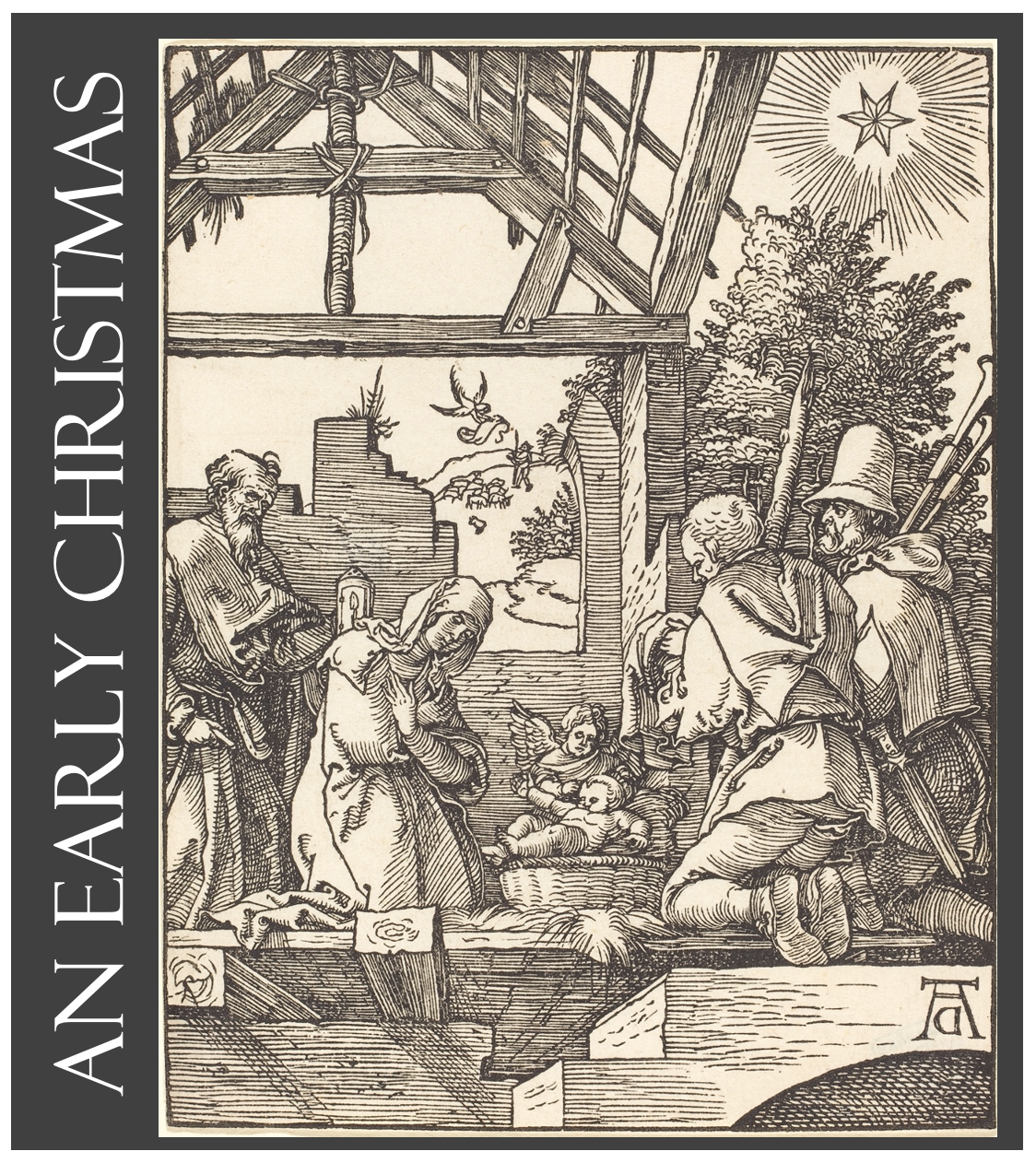
An Early Christmas

December 10 and 11, 2022

Ye sons of men, with me rejoice 🙞 Ireland, traditional, 18th century; arr. D. Johnson (2008; rev. 2022)
Daniel Johnson, soloist

Ye sons of men, with me rejoice, from the Wexford Carols, is part of an oral tradition handed down through the Devereux family of Kilmore, Ireland. The text is by Fr. William Devereux, fl. 1728; unlike our version, the Wexford Carols version contains twenty-seven verses.

Ye sons of men, with me rejoice, and praise the heavens with heart and voice!
For joyful tidings you we bring of this heavenly Babe, the newborn King.

Who from His mighty throne above came down to magnify His love
To all such as would Him embrace and would be born again in grace.

The mystery for to unfold: when the King of Kings He did behold
The poor unhappy state of man, He sent His dear beloved Son.

Within a manger there He lay; His dress was neither rich nor gay.
In Him you truly there might see a pattern of humility.

Give Him your heart the first of all, free from all malice, wrath, and gall;
And, now He’s on His throne on high, He will crown you eternally.


Lullay, lullay: Als I lay on Yoolis Night 🙞 Anonymous, 14th century, Cambridge University Add. 5943, f. 169;
Poem by John Grimestone, 1372: Edinburgh: National Library of Scotland, MS Advocates 18.7.21, f. 3v–4v;
arr. D. Johnson (2011; rev. 2022)
Jenny Houghton, soloist

TEMP has performed Lullay, lullay: Als I lay on Yoolis Night in a few of our Christmas concerts since 2011. This mystical poem in the form of a dialogue by the Franciscan friar John Grimestone in 1372 is preserved in the National Library of Scotland. Although we use only seven verses, there are thirty-seven verses in all; some middle verses may have been added later. The melody, not present in the Scottish source, is found in a separate English manuscript that gives the refrain and first verse. Our arrangement adds some polyphony, first for the mother’s reply and then for the Christ-Child’s responses. The responses of the Angel are in fauxbourdon style.

Lullay, lullay, my dear mother, sing lullay.

As I lay on Christmas Night, alone in my desire,
I thought I saw a very lovely sight,
A maid rocking her child.
Lullay, lullay, my dear mother, sing lullay.

The maiden wanted, without singing,
To put her child to sleep.
To the child it seemed that she wronged him,
And he told his mother to sing.
Lullay, lullay, my dear mother, sing lullay.

“Sing now, mother,” said the child,
“What is to befall me in the future,
When I am grown up, for all mothers do that.”

“Every mother, truly,
Who knows how to watch over her cradle,
Knows how to lull lovingly
And sing her child to sleep.”
Lullay, lullay, my dear mother, sing lullay.

“Sweet mother, fair and free, since that is so,
I pray you lull me and sing something as well.”

“Sweet son,” said she, “Of what should I sing?
I never knew anything more about you
Than Gabriel’s greeting.”
Lullay, lullay, my dear mother, sing lullay.

Certainly I saw this sight, I heard this song sung,
As I lay this Christmas Day, alone in my desire.
Lullay, lullay, my dear mother, sing lullay.


Berger, secoue ton sommeil profond! 🙞 Contrafacta of La bella noeva, Anonymous, Italy, 17th century;
France, traditional, 18th-century text; arr. D. Johnson (2013; rev. 2022)
Jenifer Thyssen, soloist

Berger, secoue ton sommeil profond! is an adapted 18th-century poem that I used to create a contrafacta of the Italian folksong La bella noeva. It is typical of the traditional music of the time, blending classical and folk elements around a simple story, in this case a very popular noël!

Shepherd, shake off your deep sleep!
The Angels from heaven sing very strongly,
Bringing us great news.
Shepherd, in chorus sing Noel!

See how the flowers open anew,
Seeing the snow as summer’s dew,
See the stars glitter again,
Throwing their brightest rays to us.

Shepherd, get up, hurry!
Seek the Babe before the break of day.
He is the hope of every nation,
All find redemption through Him.


Carol for St. Stephen’s Day (Come mad boys, be glad boys) 🙞 Anonymous, New Christmas Carols, 1642;
arr. D. Johnson (2012; rev. 2022)
Joel Nesvadba & Gil Zilkha, soloists

Saint Stephen’s Day, or the Feast of Saint Stephen, commemorates Saint Stephen, the first Christian martyr or protomartyr, celebrated on 26 December in the Latin Church, and so it is the second of the twelve days of Christmas. This text was set long ago to “Bonny sweet robin,” one of the more popular tunes of the mid-17th century. 

Come mad boys, be glad boys for Christmas is here, and we shall be feasted with jolly good cheer;
Then let us be merry, ’tis St. Stephen’s Day, let’s eat and drink freely, here’s nothing to pay.

My master bids welcome and so doth my dame, and ’tis yonder smoking dish doth me inflame;
Anon I’ll be with you, tho’ you me outface, for now I do tell you I have time and place.

I’ll troll the bowl to you then let it go round, my heels are so light they can stand on no ground;
My tongue it doth chatter and goes pitter patter, here’s good beer and strong beer, for I will not flatter.

And now for remembrance of blessed St. Stephen, let’s joy at morning, at noon, and at e’en;
Then leave off your mincing and fall to mince pies, I pray take my counsel be ruled by the wise.


We hope that some of this helps you get past Thanksgiving nostalgia and looking forward certain other celebrations (HINT HINT: Joy and Light on December 14 and 15)! We will be back in approximately exactly two weeks featuring hits from the 2023 “Joy and Light” concert! 

Stay safe, stay sane! If you’re wondering, blue is my favorite color. 
Danny

Joy and Light
Saturday, December 14, 2024 at 7:30pm at St. Martin’s Lutheran Church
Sunday, December 15, 2024 at 3:00pm at Redeemer Presbyterian Church

Back to top

In praise of short stories

Danny Johnson

Image of small pumpkins, pumpkin cornbread garnished with pumpkin seeds surrounded by a border of fall leaves.

Pumpkin Cornbread photo and recipe by Healthy Seasonal Recipes

I was thinking of following up September’s ode to Molly Bloom and pumpkin spice with a Tolkien-inspired epic about the perils of shopping/traveling/surviving during the holiday season. I came to my senses when I looked at my calendar and realized the vast number of tasks I have to begin/undertake/improve/finish in the next couple of weeks, so I’ll leave you with this: Happy Thanksgiving, and may we all have pumpkin cornbread with our meals!

By the by, we’re giving a concert in December. I think you should come! Details below.

-Danny


Joy & Light:
Delights of the Season

Saturday, December 14, 2024 at  7:30 pm
&
Sunday, December 15, 2024, 3:00 pm
Redeemer Presbyterian Church, 2111 Alexander Avenue

Hosted by Arts on Alexander on the campus of Redeemer Presbyterian Church, 
2111 Alexander Ave, Austin, TX 78722.
Visit the Arts on Alexander 2024-2025 events on the AoA website.

Admission $35 general; $30 seniors (60+); $5 students with ID
Tickets available in advance online or by cash, check, or credit card at the door.

For more information, email boxoffice@early-music.org.

Join Texas Early Music Project for its annual multilicious feast of diverse holiday music through the ages. Cultures across the centuries have celebrated this season of expectation and rebirth, and we are contributing our share with medieval chant and joyous carols, magnificent motets, sweet Celtic songs, exuberant folk-tunes, and more.

 Much of the music for this concert comes from Northern Europe, including folk tunes and chant from the Czech Republic, Germany, and Hungary that have remained popular through modern times. We have chosen three enchanting Sephardic songs for the Chanukah section, two secular and one sacred. In addition, we will present music by the “newly discovered” Vicente Lusitano, a mixed-race Portuguese composer. Active in the 16th century, Lusitano has been described as the first published Black composer.

 One of the central composers of the French Baroque, Marc-Antoine Charpentier was a master at composing graceful and exciting Christmas pastorales. We have combined one of his most popular pastorales and one of his most popular oratorios into a seamless, shorter work, featuring his intimate orchestration, solos, and choral airs. Enjoy the audio teaser from our Gaudete CD below.

Visit our Recordings page to view all of our CDs. They make great holliday gifts!

 The British Isles are represented by a variety of popular ballads and folk songs from England and Ireland, all penned by that long-lived composer, Anonymous. As usual, there will be a few pieces composed and arranged in the last few years using some of the styles of Medieval and Baroque repertoire.

 Cayla Cardiff, Joel Nesvadba, Erin Calata, Page Stephens, Jeffrey Jones-Ragona, Jenny Houghton, Ryland Angel, and Jenifer Thyssen are among the featured soloists, and we are happy to have both acclaimed harpist Therese Honey and kantele virtuoso Viktoria Nizhnik featured in our small orchestra.

Join Texas Early Music Project for a splendid and enriching evening of music. Encompassing 700 years of festive creativity and beauty, this music is sure to delight your ears and warm your heart. We coined a new word to describe the concert: multilicious!

Back to top

Taco Tuesday #109: We're serious about these tacos

Danny Johnson

Got any tacos, guv’nor?

Welp, we’re (I’m) a week behind schedule. Sorry! We had a good TEMP-Oh! Madrigal Sing last week so I guess I let that stand in TEMPorarily for the Taco. Back on track now, and we’re featuring the third Taco on the 2023 season opener! (Don’t worry – it’s all fresh ingredients. No microwaves employed.)

London City Limits: Town & Country

October 7 & 8, 2023

We began our 2023-2024 season of concerts with this lively celebration of music in England during the time frame of about 1580–1680; this is music of the people, a little bit from the courts and cathedrals, and definitely music of the pubs. The previous tacos from this concert have focused on the more light-hearted pieces, so let’s have some ‘serious’ offerings! I mean, we’re ‘serious’ about all of them… 

Although William Byrd (1539/40–1623) lived well into the 17th century, his compositional style remained rooted in the Renaissance. Following Pope Pius V’s 1570 papal bull that absolved Elizabeth’s subjects from allegiance to her and effectively made her an outlaw in the eyes of the Catholic Church, Catholicism became increasingly identified with sedition in the eyes of the Tudor authorities. Byrd’s staunch adherence to Catholicism did not prevent him from contributing prolifically to the repertory of Anglican church music or secular masterpieces, renowned for their singable lines. Although not a madrigal, our first partsong is filled with imitation, text painting, and surprising dissonances created via chromaticism (just as the text suggests.)

Come wofull Orpheus 🙞 William Byrd (1539/40–1623), Psalmes, Songs, and Sonnets, no. 19
London: Thomas Snodham, 1611
Singers

Come wofull Orpheus with thy charming Lyre,
And tune my voyce unto thy skilfull wyre,
Some strange Cromatique Notes doe you devise
That best with mournefull accents sympathize,
Of sowrest Sharps, and uncouth Flats, make choise,
And I’ll thereto compassionate my voyce.


John Wilbye (1574–1638) was heavily influenced by Morley’s lighter compositions (canzonets) and yet was able to incorporate the lightness of style into longer, more dramatic works through repetition (with sequencing and alterations) and modal changes. He never loses balance or control and maintains poise throughout the darkest melancholy. Draw on, Sweet Night includes some atypical and unusually effective techniques for the time, especially the return of the opening melodic and textual material.

Draw on, Sweet Night 🙞 John Wilbye (1574-1638); The Second Set of Madrigals for 3-6 voices, no. 31
London: Thomas Este alias Snodham, for John Browne, 1609
Singers

Draw on, Sweet Night, best friend unto those cares|
That do arise from painful melancholy.
My life so ill through want of comfort fares,
That unto thee I consecrate it wholly.

Sweet Night, draw on! My griefs when they be told
To shades and darkness find some ease from paining,
And while thou all in silence dost enfold,
I then shall have best time for my complaining.


This change of pace is a popular country dance tune found in The English Dancing-Master, which originally contained 104 dances and accompanying tunes set to the fiddle; Playford published it in 1650, but the collection is dated 1651. This popular and frequently expanded collection of music and dance steps remains the principal source of knowledge of English country dance steps and melodies to this day.

Newcastle 🙞 arr. John Playford (1623–c. 1687), arr. D. Johnson; The English Dancing Master, f. 77
London: Thomas Harper, 1651
Instruments


We will be back in approximately exactly two weeks featuring hits from a concert to be determined!  In the meantime, have you gotten your tickets yet for our holiday concert in December? Join us for Joy & Light on December 14 and 15! Stay safe, stay sane! Happy Thanksgiving!  Remember, pumpkin spice everything! 

Danny

Joy and Light
Saturday, December 14, 2024 at 7:30pm at St. Martin’s Lutheran Church
Sunday, December 15, 2024 at 3:00pm at Redeemer Presbyterian Church

Back to top

Taco Tuesday #108: More Fish and Chips Tacos!

Danny Johnson

Elizabeth woulda loved these here tacos.

I’m going to make an urgent request to TPTB to please add another several days to each month because I find myself running out of time to do all the things I have to do each month so it seems to me that a little extra time would solve the problem, no? I’m sure I wouldn’t allow myself to double down on procrastination, because that would just be the wrong thing to do, right? If you have an ‘in’ with TPTB, then please put in a good word for my plan! 

As promised, since it was ingredient-rich, we’re returning to the same concert we used for the most recent Taco.

London City Limits: Town & Country

October 7 & 8, 2023

We began our 2023-2024 season of concerts with this lively celebration of music in England during the time frame of about 1580–1680; this is music of the people, a little bit from the courts and cathedrals, and definitely music of the pubs. We will begin this Taco with a piece that was popular with Shakespeare.

O Mistresse mine (from Shakespeare’s Twelfth Night, II, iii) 🙞 Anonymous; 
consort setting by Thomas Morley (c. 1557–1602), The First Booke of Consort Lessons, Book I, No. 19, 
London: William Barley, 1599
Ryland Angel, soloist

In his short life (c.1557 – 1602), Thomas Morley was responsible for helping to stimulate the musical tastes of England by being a shrewd businessman and a composer with extensive and varied talents. Morley was the student of William Byrd, organist at St. Paul’s in London, a “Gentleman of the Chapel Royal,” probable acquaintance of Shakespeare, businessman in printing and publishing of metrical psalters, composer of sacred works, and works for keyboards, works for viols, lutes, mixed consorts, and madrigals. In short, there was very little about the musical life of late 16th-century England in which he did not play an important role. Morley’s modern popularity, though, is owing to his madrigals. O Mistresse mine survives in consort settings by Morley and keyboard settings by Byrd. Our version combines the consort setting and the version found in Twelfth Night.

O Mistresse mine, where are you roaming?
O stay and hear! Your true love’s coming,
Trip no further, pretty sweeting.
Journeys end in lovers meeting,
Ev’ry wise man’s son doth know.

What is love? ’Tis not hereafter.
Present mirth hath present laughter.
Then come kiss me, sweet and twenty.
Youth’s a stuff will not endure.


The Joviall Broome Man / Jamaica 🙞 Anonymous, 17th c., arr. D. Johnson
Roxburghe Collection of Ballads, 1633–1652?
British Library, EBBA 30105, C.20. f. 7.166–167
The Men of the Quire & Instruments

Settle in for a little whimsy: The tune of The Joviall Broome Man first appeared as a country-dance melody called both Jamaica and The Slow Men of London. Like most ballads, the origins of the text about the tall tales (or are they?) of a soldier from Kent are murky. Nonetheless, it’s a great tune with a rousing chorus! Are ye not entertained?

Roome for a Lad that’s come from seas, Hey jolly Broome-man,
That gladly now would take his ease. And therefore make me room, man.
To France, the Netherlands, Denmark, Spaine, Hey jolly Broome-man,
I crost the Seas, and backe again, And therefore make me room, man.

Yet in those countries lived I, Hey jolly Broome-man,
And see many a valiant souldier dye, And therefore make me room, man.
An hundred gallants there I kil’d, Hey jolly Broome-man,
And beside a world of bloud I spild, And therefore make me room, man.

In Germany I tooke a town; Hey jolly Broome-man,
I threw the walls there up side downe, And therefore make me room, man.
And when that I the same had done, Hey jolly Broome-man,
I made the people all to run, And therefore make me room, man.

And now I am safe returned here, Hey jolly Broome-man,
Here’s to you in a cup of English Beere, And therefore make me room, man.
And if my travels you desire to see, Hey jolly Broome-man,
You may buy’t for a peny heere of me. And therefore make me room, man.


The Honie Suckle 🙞 Anthony Holborne (1545–1602)
Pavans, Galliards, Almains and other Short Aeirs, No.60, London: William Barley, 1599
Instruments


Anthony Holborne was an accomplished lutenist, a courtier in Elizabeth’s court, and a contemporary of Thomas Morley, John Dowland, and William Byrd. Continuing a tradition passed on from the court of King Henry VIII, music in Queen Elizabeth I’s court flourished under her patronage. The Early Music Consort of London’s 1976 recording of Holborne’s The Fairie Round from his Pavans, Galliards, Almains and other Short Aeirs was included on the Voyager Golden Record, copies of which were sent into space aboard the Voyager 1 and Voyager 2 space probes in 1977, as a representation of human culture and achievement to any who might find it.


New Oysters 🙞 Thomas Ravenscroft (c.1582–1635); Pammelia: Musicks Miscellanie, No. 5
London: William Barley, 1609; arranged D Johnson, 2023
The Men of the Quire

We end today’s Taco with our adaptation of the popular round by Ravenscroft, adjusted to make dramatic sense for the street markets. Yes, we urged the singers to cut loose. Yes, they did. 

New Oysters, new Oysters, new!
Have you any wood to cleave?
What kitchen stuff have you, maids?  (kitchen stuff: refuse)


This was all pretty rowdy! I think we’ll visit this concert again with a focus on some of the brilliant ‘inner’ music!

Hey, might you wanna get rowdy with us? Join us for our Fall TEMP-Oh on Monday, Nov. 11! We’re putting some pumpkin spice on our madrigals and inviting everyone, from lowly peasants to experienced madrigalians to come to this fun community sing! This time, we’ll be joined by Guest Conductor Cina Crisara, a longtime friend of TEMP and the Conductor of the Austin Opera Chorus! We’re so excited! Suggested $20 donation to attend. RSVP today to reserve your spot!

TEMP-Oh Community Madrigal Sing
Fall Edition
Monday, November 11, 2024
7:00pm
First English Lutheran Church

We will be back in approximately exactly two weeks featuring more hits from this very concert!
Stay safe, stay sane! 

Danny

Back to top

Taco Tuesday #107: Fish and Chips Tacos

Danny Johnson

Welp, I was gonna remark about how great Fall is, but since we are currently in 4th Summer, I might want to wait a bit longer, lest I jinx the onset of true Fall. If you’re like me, and I know I am, I know you wouldn’t want that to happen. Nevertheless, we will endure the heat and start making this musical Taco that’s a little bit overdue, sorry.

Since we just finished a quite fun season-opening Paris City Limits concert, let’s go back to last year’s season opener, which was, appropriately enough, London City Limits! It was great fun, too! We will re-visit this concert for this Taco and the next one, as well. 

London City Limits: Town & Country

October 7 & 8, 2023

We began our 2023-2024 season of concerts with this lively celebration of music in England during the time frame of about 1580–1680; this is music of the people, a little bit from the courts and cathedrals, and definitely music of the pubs. We will begin this Taco with two ballads and will end with a light-hearted canzonette for 2 voices. (This last piece has personal significance: I remember singing it as a Junior in the Texas Tech U. Collegium Musicum and for a long time after that!)

Our two ballads reveal both the musical humor and the political life of the times. Early ballads were dramatic or humorous narrative songs derived from folk culture that predated printing. Originally spread via oral tradition, many ballads survive because they were printed on broadsides. (A broadside or broadsheet is a single sheet of inexpensive paper printed on one side, often including a ballad, rhyme, news, and sometimes woodcut illustrations.) Musical notation was rarely printed, since tunes were usually established favorites, such as Greensleeves or Packington’s Pound. The term ballad eventually applied more broadly to any kind of topical or popular verse.

A SATYR on the Times: Fools and Mad-men 🙞 Anonymous, based on Greensleeves, 
arr. D. Johnson
Wit and Mirth: or Pills to Purge Melancholy, ed. Thomas d’Urfey
London: W. Pearson for J. Tonson, 1719/1720, vol. VI, p. 229
Cristian Cantu & Jeffrey Jones-Ragona, soloists

Our first offering is a satire on various figures of the English populace; there are many, many verses, so I picked some of the ones most relatable to current audiences. You might recognize the basic melody (The Praise of HULL Ale) as being a variant of Greensleeves, and I added two more levels of Greensleeves-love in our instrumental sections. I created variations on dances by John Playford (1623–c. 1687) and William Cobbold (1560–1639).

A World that’s full of Fools and Mad-men,
Of over-glad, and over-sad Men,
With a few good, but many bad Men,
Which no Body can deny.

Many Lawyers that undo ye,
But few Friends who will stick to ye,
And other Ills that do pursue ye,
Which no Body can deny.

So many of Religious Sect,
Who quite do mis-expound the Text,
About ye know not what perplext,
Which no Body can deny.

Many Diseases that do fill ye,
Many Doctors that do kill ye,
Few Physicians that do heal ye,
Which no Body can deny.

And if they will not take Offence,
Many great Men of little Sense,
Who yet to Politicks make Pretence,
Which no Body can deny.

A World compos’d, ’tis strange to tell,
Of seeming Paradise, yet real Hell,
Yet all agree to lov’t too well,
Which no Body can deny.


The Cloak’s Knavery. To the Tune of  Packington’s Pound. 🙞 Roxburghe Collection of Ballads, 1660?; arr. D. Johnson;
British Library, EBBA 30194, C.20.f.9.394, p. 3.394
Ryland Angel & Jenifer Thyssen, soloists

The second ballad is a little trickier. The melody, Packington’s Pound, was already in vogue during the reign of Elizabeth, and it was applied to countless other ballads with myriad themes. The Cloak’s Knavery is thought to be an attack on the Covenant Movement and the Protestant Succession, written by someone with strong Catholic sympathies. The image of the black cloak that dominates the ballad most likely symbolizes religious ritual and there are also references to the ending of Common Prayers, which Charles I had introduced in 1637. The references to the plundering of churches also supports the interpretation that the ballad is a protest against the dominance of Protestantism and was written sometime around 1650. Again, there are many verses in the original; I moved some around and picked several of the verses that would be most easily relatable. 

Come buy my new Ballad, I have’t in my Wallet,
But ’twill not, I fear, please every Palate:
Then mark what ensu’th, for I swear by my Youth,
That every Line in my Ballad is Truth:
A Ballad of Wit, a brave Ballad of Worth,
’Tis newly Printed and newly come Forth.
’Twas made of a Cloak that fell out with the Gown,
That cramp’d all the Kingdom, and crippl’d the Crown.

I’ll tell you in Brief a Story of Grief,
That happen’d when Cloak was Commander in Chief:
It tore Common-Pray’rs, imprison’d Lord Mayors,
In one Day it voted down Prelates and Play’rs:
It brought in lay Elders could not Write nor Read,
It set publick Faith up, but pull’d down the Creed;
Then let us endeavour to pull the Cloak down,
That cramp’d all the
Kingdom, and crippl’d the Crown.

This Pious Imposter such Fury did Foster,
It left us no Penny nor no Pater Noster;
To Father and Mother, to Sister and Brother,
It gave a Commission to Kill one another:
It routed the King and Villains Elected,
To plunder all those whom they thought Disaffected:
Then let us endeavour to pull the Cloak down,
That cramp’d all the
Kingdom, and crippl’d the Crown.

This Cloak did proceed to a Damnable Deed,
It made the best Mirrour of Majesty bleed:
Tho’ Cloak did not do’t, It set it on Foot,
By rallying and calling his Journey Men to’t:
For never had come such a bloody Disaster,
If Cloak had not first drawn a Sword at his Master:
Then let us endeavour to pull the Cloak down,
That cramp’d all the
Kingdom, and crippl’d the Crown.

Though some of ’em went hence, by sorrowful Sentence,
This lofty long Cloak is not mov’d to Repentance;
But he and his Men, Twenty Thousand times Ten,
Are Plotting to do their Tricks over again:
But let this proud Cloak to Authority stoop,
Or Catch will provide him a Button and Loop,
hen let us endeavour to pull the Cloak down,
That cramp’d all the
Kingdom, and crippl’d the Crown.
For we’ll ever endeavour to pull the Cloak down,
That cramp’d all the
Kingdom, and crippl’d the Crown.


I Goe before, my darling 🙞 Thomas Morley; The First Booke of Canzonets to Two Voyces, No. 5
London: Thomas Este, 1595
Jenny Houghton & Jenifer Thyssen

Thomas Morley was a driving force in Elizabethan-era music, though often behind the scenes. His arrangements, editing, and promotion of pieces in the Italian style (occurring at the same time as the maturing of his English training) had the utmost influence on the development of the madrigal and created the standard for the other madrigalists. Although he generally eschewed the chromaticism and dramatic word-paintings of other madrigal composers, the beauty, grace, and poetic balance of his madrigals ensure their popularity for audiences and for singers, both professional and amateur. The easy lightness and humor combined with his skillful imitative writing of this duet are prime components of his canzonet style.

I Goe before, my darling,
Follow thou to the bowre in the close alley,
Ther wee will together,
Sweetly kisse each eyther,
And, lyke two wantons,
Dally, dally, dally…


Ah, yes, I remember ‘dallying’ with as much ‘ham’ as I could muster back in the old days; we were trying to convince people that early music wasn’t cold and book’ish. The struggle continues! 

How about you? Might you fancy some ‘dallying’? Join us for our Fall TEMP-Oh on Monday, Nov. 11? We’re putting some pumpkin spice on our madrigals and inviting everyone, from lowly peasants to experienced madrigalians to come to this fun community sing! This time, we’ll be joined by Guest Conductor Cina Crisara, a longtime friend of TEMP and the Conductor of the Austin Opera Chorus! We’re so excited! Suggested $20 donation to attend. RSVP today to reserve your spot!

TEMP-Oh Community Madrigal Sing
Fall Edition
Monday, November 11, 2024
7:00pm
First English Lutheran Church

We will be back in approximately exactly two weeks with a bright, shiny new Taco for you featuring more hits from this very concert! Stay safe, stay sane! 

Danny

Back to top

Taco Tuesday #106: Medieval French Crêpes

Danny Johnson

It’s been a busy 2 weeks since last we spoke/communicated/fonted. We’ve been finishing up the concert program, getting ready for rehearsals, getting all the travel plans finalized (well ok, they’ve been finalized for a few weeks now) and getting all the things ready for this week’s concert. More about that at the end. 

As promised, we are back with some more Musical Tacos from our Covid-lockdown era concert video with music from Medieval France, and this time we’re featuring the women. Let’s get started! 

Ah, Sweet Lady: Passion in Medieval France

A Video Premiere for the Public
Saturday, September 12, 2020

Montpellier Codex

The Montpellier Codex contains early polyphonic works in France and was likely compiled around 1300. While many of the texts deal with some truly tender variations on love themes as well as more jovial ones (“I love B but C loves me and I don’t know what to do, because B loves D who loves C...”), there are others about country kids visiting the big city (Paris) with Medieval versions of the still popular trope.

S’on me regarde /Prennés i garde/ Hé, mi enfant Montpellier Codex, Bibliothèque interuniversitaire de médecine, H. 196, Mo Fasc. 8, No. 325, f. 375v–376v

Triplum: Gitanjali Mathur & Jenifer Thyssen
Motetus: Cayla Cardiff & Shari Alise Wilson
Tenor: Nooshin Wilson & Laura Mercado-Wright

 [In order of performance:]
Motetus:
Take note, if someone looks at me;
I am too daring, so tell me, in the name of God, I beg you.
For when one looks at me, I can hardly wait
For him to have me with him;
And I see another here who is, I believe,
 (May hell fire burn him!) jealous of me.
But I refuse to cease loving on his account,
It doesn’t do him any good to watch me, he’s wasting his time:
I’ll find an escape and have the love of my sweetheart.
I must do it; I will be a coward no longer.

Triplum:
If anyone is looking at me, tell me;
I see well that I am too daring;
I can’t stop my gaze from wandering,
For when a certain one looks at me,
I can hardly wait for him to have me with him
And receive in faith the gift of my love fully.
But here I see another who is, I believe,
(May hell fire burn him!) jealous of me.
But I refuse to cease loving on his account,
For by my faith it doesn’t do him any good to watch me,
He’s wasting his time: I’ll find an escape!

Tenor:
Hé, my child!


Guillaume de Machaut, c. 1300–1377

And now we’re back to the music of Guillaume de Machaut. He was not only a poet of high regard, but also a composer of both musical miniatures and larger works. When I was an undergraduate music student, learning about him was yet another life-changing experience. The New York Pro Musica Antiqua had recently released their album, Ah Sweet Lady: The Romance of Medieval France, with works by Machaut and others, and it was a great way to introduce us to the amazing possibilities of this music. This was another disc (of many) that I listened to so much that I created grooves in the album. (Yes, I apologized to the music librarian!) The title of our concert is a tribute to the New York Pro Musica album. I think that spending so much time with those records as well as singing music by Machaut in the very first Texas Tech University Collegium Musicum concert was when I became hooked on early music. At that time, I didn’t know how long that relationship would last. 

De triste cuer/Quant vrais amans/Certes, je di Ballade 29, Paris, 
Bibliothèque Nationale de France
Triplum: Gitanjali Mathur & Jenifer Thyssen
Motetus: Cayla Cardiff & Shari Alise Wilson
Tenor: Nooshin Ghanbari & Laura Mercado-Wright

Triplum:
From a sad heart to compose joyfully, that, I think, is a thing contrary;
But he who composes out of joyous feelings,
I say should compose more joyfully.
And so it is that my songs are rude,
They come from a heart blacker than peat,
Grieving, distressed, weeping tears of blood.

Tenor:
Truly, I say, and in this ask to be judged,
That, when Love oppresses and tortures a heart, 
Because it can receive no comfort
From his lady, noble and of high bearing,
Then the suffering which Alexander wrought on Darius
Is not so great as that which falls on him,
Grieving, distressed, weeping tears of blood.

Motetus:
When a true lover loves lovingly
With such true heart that he can do no wrong,
And his lady has such a heart that he can in no way
Draw from it mercy, sweetness or grace,
His heart cannot be so debonair that its liquor would not run to his eye,
Grieving, distressed, weeping tears of blood.


Se je souspir parfondement Virelai 36/30, Paris, Bibliothèque Nationale de France
Gitanjali Mathur, soloist
Elaine Barber, harp & Bruce Colson, vielle

If I sigh deeply and tenderly weep in secret, it is, I swear, for you,
When your noble fair body, my lady I do not see.
Your sweet demeanor, simple and modest, your fair carriage, pretty and pleasing, 
Your fearless manner, these three have seized me so sweetly
That to you most lovingly and entirely I give and entrust my heart,
Which far from you has no joy nor pleasure.

If I sigh deeply and tenderly weep in secret, it is, I swear, for you,
When your noble fair body, my lady, I do not see.

Lady, you have put me in such a plight, I clearly see, that, in truth,
I use my senses, time and life for you and always believe in this fortune.
And if I am far from relief and hear very little of mercy
I do not swerve, for such a great honor I do not deserve at all.

If I sigh deeply and tenderly weep in secret, it is, I swear, for you,
When your noble fair body, my lady, I do not see.


Jehan Vaillant, fl. 1360–1390

Par maintes foys Virelai, Bibliothèque du château de Chantilly, MS 564, f. 60
Cayla Cardiff & Shari Alise Wilson, soloists
Elaine Barber, harp ~ Bruce Colson, vielle
Scott Horton, gittern ~ John Walters, vielle

How many times are the skies filled
With the sweet song of the nightingale!
But the cuckoo never joins in;
He prefers to sing enviously.
“Cuckoo, cuckoo” all his life.
He wants his song to bring discord.
So the nightingale cries out:
“I command that you shall be killed.
Slain, slain, killed, killed, fie upon you, fie upon you,
Cuckoo who wants to speak of love.”

“I beg you, my very sweet skylark,
Thus to sing your song:
Lire, lire, liron, as God tells you.”
It’s time for the nightingale’s little song:
“Killed, they’re killed, those who wage war with you.”

“Flock together, bring the goldfinch
And make him and the starling sing out.
Kill the cuckoo and silence him.”
He is taken, let him be killed.
In the lovely springtime
Praise the hawk, our friend, our friend;
And praise the god of love.


Speaking of bird songs, be sure to catch this weekend’s concert and Clément Janequin’s brilliant Le chant des oiseaux, during which you might think you’re in a Renaissance forest! 

We’ve almost reached our goal for our CariCATures fundraising campaign! Can you help us get across the finish line? We have just about $3000 left to meet our $15,000 goal. Thank you so much for your support of early music in Austin and beyond!

We will be back in approximately exactly two weeks with a lovely new Taco for you!

Stay safe, stay sane! 

Danny

Back to top

Taco Tuesday #105: Tacos from Medieval Frenchmen

Danny Johnson

So, here we go, and it’s about time! The new concert season is upon us, there’s a hope for mostly cooler days and nights, and, if you noticed in my concert blog earlier this week, it’s time for all things pumpkin spice to make a re-entry into our atmosphere! Still looking for the pumpkin spice contact lens solution, though. I’ll let you know when I find it! 

Since our first concert of the season is coming up in 19 days and it’s all about Renaissance France, I thought we should get prepared for Renaissance France by listening to some pieces from Medieval France from a concert that didn’t happen–well, not as planned. It was originally scheduled for the end of March in 2020 and we all recall 2020, right? Since we couldn’t do live concerts, we created our first video concert; it was quite an experience. Everyone had to record their bits alone and then we had to edit all the individual tracks and video into a unified track. Such a learning experience, but we quickly got into the fun of it, and we were so glad to be able to make use of this method so that we could be in touch with our fans (and a lot of new fans) who were stuck at home! 

So today’s Taco will feature the TEMP men; in approximately exactly two weeks, we’ll feature the TEMP women from the same concert. 

Ah, Sweet Lady: Passion in Medieval France

A Video Premiere for the Public
September 12, 2020

Montpellier Codex

The Montpellier Codex contains early polyphonic works in France and was likely compiled around 1300. While many of the texts deal with some truly tender variations on love themes as well as more jovial ones (“I love B but C loves me and I don’t know what to do, because B loves D who loves C...”), there are others about country kids visiting the big city (Paris) with Medieval versions of the still popular trope.

Pucelete bele et avenant/Je languis des maus/Domino Montpellier Codex, 
Bibliothèque interuniversitaire de médecine,
Triplum: Ryland Angel & Jeffrey Jones-Ragona
Motetus: Cristian Cantu & David Lopez
Tenor: Daniel Johnson & Tim O’Brien

[In order of performance:]
Motetus:
I languish with the pain of love:
I prefer that it kills me rather than any other malady;
Death is so sweet.
Swear to me, sweet beloved, that this sickness of love will not kill me.

Triplum:
A little maid, comely and fair, so pretty, graceful and pleasing,
The charming little one whom I desire so much,
Makes me happy, joyful, light-hearted and loving:
A nightingale singing in May is not so gay.
I will love with my entire heart
My little dark-haired sweetheart joyfully.
Fair sweetheart, you who have so long had my life in your power,
I cry out to you for mercy with a sigh.

Tenor:
Oh


Plus bele que flor/Quant revient/L’autrier joer/Flos [Filius Eius] Montpellier Codex, Bibliothèque interuniversitaire de médecine
Quadruplum: Cristian Cantu
Triplum: Ryland Angel
Motetus: Daniel Johnson
Tenor: Tim O’Brien

[In order of performance:]
Motetus:
The other day, I went off along a detour.
I entered an orchard to gather some flowers.
I found a pleasant Lady, of fair mien.
She had a happy heart and sang out with great emotion:
“I have Love! What will I do with it?
It is the end, the end; whatever anyone says, I will love.”

Quadruplum:
More beautiful than a flower, in my view
Is the one to whom I devote myself.
As long as I exist, in truth,
No one will have the joy nor delight of my love
Except for this flower which is from Paradise:
She is mother to our Lord, who wants forever, friend,
To possess you and the two of us together.

Triplum:
When the return of leaf and flower
Signal the arrival of the summer season,
God, that is when I think of Love,
Who always has been courteous and sweet to me.
Much do I love her solace, for her good will softens my pain.
Much goodness and honor come to me from being in her service.

Tenor:
Flos [Filius Eius]


Guillaume de Machaut, c. 1300–1377

Speaking of the past (and we often are): When I was a sophomore at Texas Tech University, we studied Medieval music as part of our music history classes, and I was lucky enough to have a teacher (Dr. Paul Cutter) who was entranced by early music. After studying about chants and other beguiling repertoire, which was all very interesting and fun, we were introduced to the music of Guillaume de Machaut. He was not only a poet of high regard, but also a composer of both musical miniatures and larger works; for me, this introduction was yet another life-changing experience. The New York Pro Musica Antiqua had recently released their album, Ah Sweet Lady: The Romance of Medieval France, with works by Machaut and others, and it was a great way to introduce us to Machaut. I think that spending so much time with those records as well as singing music by Machaut in the very first Texas Tech University Collegium Musicum concert was when I became hooked on early music. At that time, I didn’t know how long that relationship would last. 

Quant je sui mis au retour Virelai 13, Paris, Bibliothèque Nationale de France, fonds français
Tim O’Brien, soloist
Elaine Barber, harp
John Walters, vielle

When I’ve been to see my lady,
I feel neither pain nor sorrow, upon my soul.
God! It’s only right that I should love her, Blamelessly, in true love.

Her beauty, her great sweetness of amorous heat,
Through memory, night and day,
Burns and ignites me.
God! It’s only right that I should love her,
Blamelessly, in true love.

And when her noble worth penetrates my loyal heart,
I wish to serve her without thought of folly or infamy.
God! It’s only right that I should love her,
Blamelessly, in true love.


We will be back in approximately exactly two weeks with a bright, shiny new Taco for you featuring the TEMP women from this very concert!

Don’t forget to get your tickets for Paris City Limits on September 28 and 29!

Also, we’re smack dab in the middle of our Fall Fundraising Campaign. Can you help us reach our goal of $15,000? With a gift of any size, you are helping TEMP remain a leader in preserving and advancing the art of Medieval, Renaissance, Baroque, and early Classical music through performance, recordings, and educational outreach. Plus, there’s more musical tacos in it for you! If you can, please make your gift today. And thank you!

Stay safe, stay sane! 

Danny

Back to top

Paris in full bloom, with spice

Danny Johnson

Wow! You know, we almost scheduled a preview concert of our upcoming Paris City Limits program in actual Paris this summer, but then someone scheduled the Olympics there so we decided to wait and stay closer to home. I mean, the traffic alone deterred us. I know we could have waited until the Fall and we could do the Paris concert in Paris then, but we would miss some of the other important goings-on here in AusTex! Besides, I don’t know if you can get a latte aux épices de citrouille there, not that I’ve ever had a bona fide, certified PSL here. But that brings us to the heart of the matter:

It’s September, when we locals begins to look forward to the finer things of life, including cooler weather for several months at a time, so we can begin to enjoy outdoor spor… I mean musical activities and festivals and walks through the Hill Country on a cool autumn day and watch out for that cactus and there’s nothing like nature yes the wild mountain cedar then the sneezes and the rushing yes for the tissues yes then the beautiful country with fields of oats and wheat and buckwheat yessss I said buckwheat and yes I’ll have another buckwheat pancake and yes I would yes even as we see rivers and streams yes and culverts and wildflowers of all sorts of shapes and smells and… Whoa! What is that intoxicating aroma wafting through the junipers and cedars? Of course, it’s the perfume of the wild pumpkin spice!! I forgot, it’s September!! We’ve finally finished August, aka that long pre-pumpkin-spice month! 

Ok, I know I digressed, but I must go. I need to begin my search for you-know-what while I’m finishing up the work on our Paris concert (in Austin). Check out all the details below. I need to find a latte aux épices de citrouille, stat!!

—Danny


Paris City Limits:
Circa 1550

Saturday, September 28, 2024 at  7:30 pm
&
Sunday, September 29, 2024, 3:00 pm
Redeemer Presbyterian Church, 2111 Alexander Avenue

Hosted by Arts on Alexander on the campus of Redeemer Presbyterian Church, 
2111 Alexander Ave, Austin, TX 78722.
Visit the Arts on Alexander 2024-2025 events on the AoA website.

Admission $35 general; $30 seniors (60+); $5 students with ID
Tickets available in advance online or by cash, check, or credit card at the door.

For more information, email boxoffice@early-music.org.

We’ve named our 2024-2025 season Reconnections: Reflections with friends, old and new. Our most recent Paris City Limits concert was almost exactly six years ago, and we all know that is a long time to be separated from a dear friend. How fortunate that the dear friend in question has such a rich history: Renowned for its popular music of France from the 16th and 17th centuries, Paris City Limits regales audiences with exuberant dances, popular folk songs, dazzling chansons, and heartfelt songs of love and melancholy by both the masters of the day and some relative unknowns.

Imagine a music festival that explores the rustic and sophisticated musical hits of 16th-century Paris and its environs. There are some top hits by Josquin and Lassus, some lyrics by the leading serious poet of the time, Pierre de Ronsard, as well as wondrously gentle and touching songs by Janequin and the new kid on the rue, Pierre Clereau. Then it will be time for some exuberant Breton dances to put a smile on your face and a tap in your foot.

There are dozens of chansons attributed to the master of the day, Josquin des Prez, and we will be performing four of them. Three of those four are for six parts, allowing the master to experiment with textures and harmonies. As the finale, TEMP’s 16-voice chorus will perform Janequin’s spectacular and picturesque chanson about the birds (Le chant des oyseaux). Enjoy the audio teaser from our Paris City Limits CD below.

Click/tap on the CD cover images to enjoy more audio samples
and visit our Recordings page to view all of our CDs.

Our featured singers for this year’s Paris City Limits include TEMP regulars Jenifer Thyssen, Adrienne Pedrotti Bingamon, Jenny Houghton, Cayla Cardiff, Page Stephens, Jeffrey Jones Ragona, Ryland Angel, and more. The instrumental ensemble features harpist Elaine Barber, violinist Bruce Colson, our viol consort (Mary Springfels, Kit Robberson, Joan Carlson, John Walters, and David Dawson), recorder player Susan Richter, and lutenist Héctor Alfonso Torres.

Venez, y’all!

Back to top

The Ides of April.

Danny Johnson

Is that a thing, or not? Discuss.

Hmmm April 15. Seems like I’m supposed to be doing something important today. I mean, I do recall that on March 15, I made sure to avoid going to the Roman Senate, but I have this stabbing feeling that I’m missing something about today. So I made a little list of possibilities.

I do recall that I wanted to let you all know that you should check out TEMP’s Musical Taco that is coming out tomorrow, April 16. It’s monumental: Our 100th Taco! We started making them during the COVID 19 lockdown so we could provide a little solace, humor, news, and music for you while we were working remotely. (The idea was Mary Ashton’s, I’m pretty sure!) We made them weekly for several months and then moved to every two weeks, and now we mostly get them to you every two weeks. ’Ish. Sometimes.

So then, in an effort to avoid thinking about what I was supposed to do on April 15, I got curious and counted the number of blogs we’ve released since we started doing these. To my astonishment, I discovered that this might be the 114th blog. Yes, I lost count.

And so then, forgetting that April 15 was something I was even supposed to be concerned about, I decided to count the number of concerts that TEMP has given. The answer: Not enough. To that end, I’m glad to announce TEMP’s next concert, the final one for the 2023-2024 Season. It’s Italian all the way, with lots of ‘firsts’ involved. See details below!

And, as we said way back in 2014 before a similarly-themed concert:

Preservare il passato. Arricchire il presente. Coinvolgere il futuro.
Si tratta di musica antica in una luce completamente nuova. Unisciti a noi.

Meanwhile, I guess I’ll find out on April 16 what it was that I forgot to do on April 15.

Saluti!
–Danny


Italia mia:
Diverse Voices of the Late Renaissance

Saturday, May 11, 2024 at  7:30 pm
&
Sunday, May 12, 2024, 3:00 pm
Redeemer Presbyterian Church, 2111 Alexander Avenue

Hosted by Arts on Alexander on the campus of Redeemer Presbyterian Church, 
2111 Alexander Ave, Austin, TX 78722.
Visit the Arts on Alexander 2023-2024 events on the AoA website.

Admission $35 general; $30 seniors (60+); $5 students with ID
Tickets available in advance online or by cash, check, or credit card at the door.

For more information, call 512-377-6961 and leave a message,
or email temp@early-music.org.

Through the happy union of musicology and live performance, we can now present music to you that was not available or even known just a few short years ago. Due to recent research, we are able to present madrigals by Maddalena Casulana, the first woman composer to have an entire book of her music published. Some of her music wasn’t discovered until quite recently, so we are fortunate to have this timely opportunity. Likewise, music by the first published Black composer, Vicente Lusitano, hasn’t been available to us until the last few of years. His mastery of Renaissance polyphony and inventiveness create a wonderfully rich and beautiful architecture of sound. Although he has been in our sights for quite some time, this is the first program in which we can really explore music by Salomone Rossi, Italian Jewish violinist and composer who, like Monteverdi, was a transitional figure between the late Italian Renaissance period and early Baroque. This should give just an idea of some of the incredible musical diversity available in Italy, the heart of the Renaissance, from about 1538 until about 1638, when tastes and styles transitioned from the Renaissance aesthetic to the beginnings of the Baroque.

In addition to these brilliant but relatively unknown composers, we will feature both chamber and large-scale choral works by Monteverdi, excerpts from La Pellegrina, (the 1589 extravaganza created for an important Medici wedding), and intimate or casual pieces that are suitable for the end of our 2023-2024 Street Songs season. And we couldn’t pass up the opportunity to sing the stirring title piece, Italia Mia, by Philippe Verdelot.

Our 20-voice choir will also provide the vocal soloists for the concert, and will include Jenifer Thyssen, Jenny Houghton, Shari Alise Wilson, Jeffrey Jones-Ragona, Page Stephens, Adrienne Pedrotti Bingamon, Ryland Angel, and others. TEMP’s small orchestra of viols, violin, and plucked strings will feature Mary Springfels, Therese Honey, and theorbist Héctor Torres.

Join us as we explore 100 years of a variety of the delicious tastes of Italy
(not including some of those favored by Lucrezia Borgia…)

Click on the image above to  buy tickets now!

Back to top

Scorching Hot Valentines…

Danny Johnson

Codex Buranus, München: Bayerische Staatsbibliothek, Clm 4660, f. 72v

…for my Friend, Billy Pilgrim

My “Spidey sense” tells me that it’s Valentine’s Day! Dang, I didn’t put up a tree or anything. Didn’t send any cards. Bought no prezzies. Didn’t think of putting up any lights, although I guess I could finally take down my Halloween decorations. Then again, Halloween is just around the corner, I think, so I may as well leave them up. That reminds me that my email used to be @soon.com, in honor of the curious relationship I have with time. I’m thinking about changing my ways. Maybe next year or so. You know: ’ish.

Anyway, since it’s Valentine’s Day, then that means we have must have a concert coming up. Or perhaps we already did it? Nope, nope, I’m pretty sure we haven’t done it because I’m really looking forward to it. I do remember that I haven’t experienced the joys of a live Medieval Carmina Burana concert in about 6 years, so it’s still on the way. And speaking of love poetry for Valentine’s Day, those 13th-century poets wrote some scorchers! Carmina Burana is just full of them! You should send Billy Pilgrim an earnest/scorching hot Valentine. Maybe it will entice him to come home from Tralfamadore.

I bet there will be details below. I should look at the details too, so I don’t schedule taking down my Valo-ween decorations at the same time.

But you should watch the video of our December Joy & Light concert before it goes away on Feb 26 and then come to the Carmina Burana concert shortly after that. One can never celebrate too many holidays at the same time.

And Happy Valentine’s Day!
–Danny


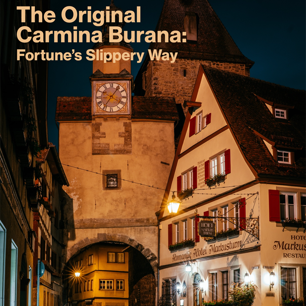
THE ORIGINAL CARMINA BURANA:
FORTUNE’S SLIPPERY WAY

Saturday, March 2, 2024 at  7:30 pm
&
Sunday, March 3, 2024, 3:00 pm
Redeemer Presbyterian Church, 2111 Alexander Avenue

Hosted by Arts on Alexander on the campus of Redeemer Presbyterian Church, 
2111 Alexander Ave, Austin, TX 78722.
Visit the Arts on Alexander 2023-2024 events on the AoA website.

Admission $35 general; $30 seniors (60+); $5 students with ID
Tickets available in advance online or by cash, check, or credit card at the door.

For more information, call 512-377-6961 and leave a message,
or email info@early-music.org.

Neil deGrasse Tyson mentioned the 13th-century manuscript Carmina Burana on his documentary TV series, Cosmos: A Spacetime Odyssey! What he didn’t say was that it contains unabashedly joyful and passionate songs about love, spring, mythology, love, dancing, drinking, love, flirting, philosophy, and…love!

Although Carmina Burana was given wide name recognition in 1937 by the composer Carl Orff, whose cantata of the same title popularized some of the Medieval texts and brought its existence into the light, the original version deserves just as much attention. With images of the cycle of the seasons and melodies which were often based on the most popular tunes, polyphony, and dances from Western Europe at the time, the songs of Carmina Burana reflect the lives of the 12th- and 13th-century Bavarian monks and students who collected and/or composed the pieces in this famous anthology. The poems, at once sensual and refined, satirical and sincere, offer a fascinating glimpse into life in the late Middle Ages. There are songs of love and flirtation, verses in praise of good food and good wine, diatribes against gossip and jealousy, odes to mythical heroes—all of these and much more are found in this extraordinary compilation of songs, dances, and chants.

The music is as varied as the texts, with melodies that are memorable and hummable. There are melodies clearly influenced by chant, by popular tunes, or by dances—sometimes all within the same song. Some of the selections from the Carmina Burana are among the most popular of TEMP’s medieval repertoire: Veris dulcis in tempore, sung by women, is both haunting and joyful in its exultation of springtime and the importance of love; Sic mea fata canendo solor is an exultant ode from a young man as he thinks about his love and describes his feelings in delicious detail! Did we mention that this concert is rated PG-13?

TEMP will feature some of its favorite soloists, including Jenifer Thyssen, Cayla Cardiff, Jenny Houghton, Jeffrey Jones-Ragona, Page Stephens, Ryland Angel, and others. Our 10-piece medieval orchestra with its enchanting timbres and delightful combinations features medieval fiddles or vielles, oud, early harps, psaltery, recorder, and more. Of particular interest will be the northern European string instruments kantele and jouhikko, played by Viktoria Nizhnik.

Prepare for the arrival of spring with this rousing look at Medieval passions!

Click on the image above to  buy tickets now!

Back to top

Joy, Light, & Everything Pumpkin Spice

Danny Johnson

Welp, we all know what’s about to happen, right? I’m gonna make a reference to the artificial jet lag created by the time change and that I kinda like it. And then I’m gonna say something like “it must be that time of year for another sweet potato curry, washed down with a pumpkin stout, and then chased by a slice of pumpkin cheesecake” or somesuch.

So let’s just cut to the chase, shall we?

Time’s a’wastin’ because I need to be finalizing the music for our Joy and Light concert in December and preparing for the Fall Texas Toot workshop in East Texas and trying to make time to watch our London City Limits concert video because we spent a lot of time on the concert and the audio/video editing and it’s pretty danged good! You should watch it. Details are on our website.

Carton of Trader Joe's Pumpkin Ice Cream Super Premium

So, you see, rather than go on and on about not being able to find any pumpkin spice contact lens solution, I’m gonna get back to work! And think about the pumpkin spice ice cream I might have during a break.

See details about about our upcoming Joy and Light concert below!

And Happy Thanksgiving!
–Danny

P.S. Don’t forget: TEMP CDs make great holiday gifts! Purchase CDs at our concert venue or order from our Recordings page!


Joy and Light: Delights of the Season

Saturday, December 9, 2023 at  7:30 pm
&
Sunday, December 10, 2023, 3:00 pm
Redeemer Presbyterian Church, 2111 Alexander Avenue

Hosted by Arts on Alexander on the campus of Redeemer Presbyterian Church, 
2111 Alexander Ave, Austin, TX 78722.
Visit the Arts on Alexander 2023-2024 events on the AoA website.

Admission $35 general; $30 seniors (60+); $5 students with ID
Tickets available in advance online or by cash, check, or credit card at the door.

For more information, call 512-377-6961 and leave a message,
or email info@early-music.org.

Join Texas Early Music Project for its annual multilicious feast of diverse holiday music through the ages. Cultures across the centuries have celebrated this season of expectation and rebirth, and we are contributing our share with medieval chant and joyous carols, magnificent motets, sweet Celtic songs, exuberant folk-tunes, and more.

 Much of the music for this concert comes from Southern Europe, including folk tunes from France that have remained popular through modern times as well as newly written pieces based on French chant. The enchanting Sephardic songs that we have chosen for the Chanukah section come from Turkey and Morocco. In addition, we will present music by the “newly discovered” Vicente Lusitano, a mixed-race Portuguese composer. Active in the 16th century, Lusitano has been described as the first published Black composer.

 In addition to the haunting motet for 5 voices by Lusitano, we have created a “medley” on the popular 14th-century tune In dulci jubilo (also known to modern carolers as Good Christian Men, Rejoice), using settings by different composers of the German Renaissance and Baroque: Michael Praetorius, Hieronymus Praetorius, and Dietrich Buxtehude. The settings range from verses for 2 parts, 3 parts, and so on, up to 12 different parts.

 The British Isles are represented by a variety of popular ballads and folk songs from England and Scotland, all penned by that long-lived composer, Anonymous. As usual, there will be a few pieces composed and arranged in the last few years using some of the styles of Medieval and Baroque repertoire.

 Tim O’Brien, David Lopez, Cayla Cardiff, Erin Calata, Page Stephens, Jeffrey Jones-Ragona, Jenny Houghton, Ryland Angel, Adrienne Pedrotti Bingamon, and Jenifer Thyssen are among the featured soloists, and we are happy to have both acclaimed harpist Therese Honey and kantele virtuoso Viktoria Nizhnik featured in our small orchestra.

 Join Texas Early Music Project for a splendid and enriching evening of music. Encompassing 700 years of festive creativity and beauty, this music is sure to delight your ears and warm your heart. We coined a new word to describe the concert: multilicious!

Banner with text: Joy and Light: Delights of the Season

Click on the image above to buy tickets now!

Back to top

A Day in the Life of the Market

Danny Johnson

“Buy my fine singing Glasses” from The Cryes of the City of London Drawne After the Life, by Marcellus Laroon (London, 1687)

“Buy my fine singing Glasses” from The Cryes of the City of London Drawne After the Life, by Marcellus Laroon (London, 1687)

Well, it finally happened; I knew it was coming and just kept putting it off. It was time to go shopping and I knew that pandemonium and chaos would engulf me for a while. But it was necessary. It was necessary to buy some fair bone lace, some cambric, buskins, doublets, and small coals. I also needed to find a cooper and to talk to the town crier about my old lost mare.

It was indeed as loud and unruly as I feared, with all sorts of vendors trying to entice me to buy oysters and haddock and sprats and cowcumbers and marking stones and raspis and … well, the variety was interminable. But — you know, after a while I sorta zoned out and listened to the wonderful harmonies that were being created by all this din and spontaneous vocal advertising. I eventually found all the items I was seeking and gave the crier my notice about my horse. Then I left, went to Wheatsville, and I bought some organic yogurt, some Ceylon cinnamon, an espresso (double), and got some victuals at the deli. Altogether a successful venture.

“Twelve pence a peck oysters” from The Cryes of the City of London Drawne After the Life, by Marcellus Laroon (London, 1687)

I must say I was reminded of this wonderful piece by Richard Dering, The City Cries from the early 17th century, in which he depicts a similar scene at the London street markets in c. 1615. Of course, the vendors don’t all ‘yell/sing’ at the same time; Dering lays the whole thing so you can hear the individual characters, all supported by a consort of viols.

Whoa! Such serendipity! TEMP happens to be performing that piece in its season opener October concert! You should check it out; I hope to be there! It’s also TEMP’s 25th concert season, a momentous occasion! There’s more info below.

I think I’ll go to the market again today. I need to talk to the chimney sweep.

New oysters, anyone?

Danny


London City Limits: Town & Country

Saturday, October 7, 2023 at  7:30 pm
&
Sunday, October 8, 2023, 3:00 pm
Redeemer Presbyterian Church, 2111 Alexander Avenue

Hosted by Arts on Alexander on the campus of Redeemer Presbyterian Church, 
2111 Alexander Ave, Austin, TX 78722.
Visit the Arts on Alexander 2023-2024 events on the AoA website.

Admission $35 general; $30 seniors (60+); $5 students with ID
Tickets available in advance online or by cash, check, or credit card at the door.

For more information, call 512-377-6961 and leave a message,
or email info@early-music.org.

Thanks to boosts from popular culture on television and in movies, more people than ever are aware of and interested in the very important Tudor courts of Henry VIII and his daughter, Elizabeth I. During the time they ruled England—more than 90 years, from 1509 until 1603—England’s influence in the world increased dramatically and English musical and artistic culture became more prominent. Our concert picks up towards the end of Elizabeth’s reign and concludes during the second reign of the House of Stuart, at the end of the 17th century. This repertoire for voices, viols, and lutes fashions a colorful account of life in and around London for almost 100 years. This is music from the streets, the theater, the Tudor courts, and the cathedrals. Also, in honor of the 400th anniversary of the passing of one of Britain’s most important composers, we will have choral pieces by William Byrd (1543–1623). 

In those times, shoppers at street markets around the world would have heard various vendors hawking their wares with unique cries and slogans. In the later years of Elizabeth I and beyond, a popular style of composition came about that combined quite a number of these oral advertisements into notable compositions, both comedic and informative, while still being delightful. Richard Dering’s The City Cries presents a full day in the life of the market with more than 70 distinct characters/vendors represented by 13 singers in our performance.

We will have graceful songs and dances from Shakespearean productions and courts, vocal pieces suitable for singing in private homes, and more sophisticated pieces for the professional singers in the courts and cathedrals. These pieces are composed by well-known madrigalists such as Thomas Morley, Thomas Weelkes, Thomas Campion (I detect a trend), and others.

Enjoy these audio teasers from our CD Building Bridges to the Past, which will also be in London City Limits! 

A little later in the century, there are the social and political commentary songs, mostly ballads from the Pills to Purge Melancholy, a collection of broadsides and ballads. Some of the poems broach the issue of groups of people who are suppressed in order to elevate other groups, simply because the “powers that be” could, in fact, do so. The most dramatic piece of the concert is probably The Cloak’s Knavery, another ballad that speaks of political malevolence that leads to societal ills.

Although she performs with us so often she could be considered to be a regular, she’s still our special guest: viola da gamba superstar Mary Springfels (New York Pro Musica, Waverly Consort, Sequentia, the Newbury Consort, and more) will lead our consort of viols. Likewise, countertenor/tenor Ryland Angel joins us again and will perform solo and small ensemble works, along with other soloists Jenifer Thyssen, Cayla Cardiff, Jeffrey Jones-Ragona, Jenny Houghton, Adrienne Pedrotti Bingamon, Page Stephens, and others.

Help us celebrate our 25th Season!

Click on the image above to buy tickets now!

Did you enjoy this post? Give us a “like” below, leave a comment, and/or share with friends!

Back to top

Going on Pilgrimage…

Danny Johnson

…and I have nothing to wear!

Pilgrim's outfit belonging to Stephan Praun (1544-1591). Germanisches National Museum

Greetings, and many thanks to all who have written to congratulate us on getting the services of that renowned designer of the finest haute couture pilgrimage-wear, Yves de St. Jaime-en-el-Cielo-con-Diamanté, who has sent some preliminary photos of the gorgeous smocks we will all be wearing on this and other pilgrimages.

All of his designs will be replete with staffs, rosaries, and scallop shells, which have traditionally been the symbol of a pilgrimage to the tomb of St. James the Apostle in Santiago de Compostela. (Click on the image to enlarge.)


Sadly, due to supply chain issues, we will not be able to supply everyone with their very own Tarta de Santiago, the traditional almond cake that is available for pilgrims at the Cathedral of Santiago de Compostela. Feel free to make and bring your own cake!

A veces se gana, se pierde algo. (You win some, you lose some.)

Don your most fashionable pilgrimage gear and come to our Medieval Pilgrimage concert! Details below.

Danny


Medieval Pilgrimage in Iberia

Saturday, May 13, 2023 at  7:30 pm
&
Sunday, May 14, 2023, 3:00 pm
Redeemer Presbyterian Church, 2111 Alexander Avenue

Hosted by Arts on Alexander on the campus of Redeemer Presbyterian Church, 
2111 Alexander Ave, Austin, TX 78722.
Visit the Arts on Alexander 2022-2023 events on the AoA website.

Admission $35 general; $30 seniors (60+); $5 students with ID
Tickets available in advance online or by cash, check, or credit card at the door.

For more information, call 512-377-6961 and leave a message,
or email info@early-music.org.

Map showing the pilgrimage routes to Santiago de Compostela.

There was never a more popular time for religious pilgrimage than during the Middle Ages. In those times, people made long and dangerous trips, lasting months or years, in a search for spiritual meaning or fulfillment or as an act of penance. Several of the most important sites of pilgrimage during the Middle Ages were located in what is now northern Spain. 

Llibre Vermell: Stella splendens

The Llibre Vermell (it was discovered in a red binding in the 19th century, and therefore is called the Red Book) comes from the monastery at Montserrat in Catalonia. Some of the music is sophisticated, but some of it was intended to be sung by the pilgrims themselves and included chants, rounds, folk songs, circle dances, and polyphony. We will also perform music from the Cistercian convent in Burgos (Las Huelgas Codex), Las cantigas de Santa Maria from the royal court of Alfonso X, and selections from Codex Calixtinus, from the Cathedral in Santiago de Compostela in Galicia.

Enjoy these two Llibre Vermell audio teasers from our related CDs: Stella splendens and Sacred.

A company of fourteen women singers explores the music of pilgrimage in Medieval Spain. This music celebrates the richly transparent timbre of treble voices in unison or in polyphonic settings, making the most of sweet consonances and pungent dissonances. Mary Springfels (vielle and citole) joins the ensemble and the TEMP Medieval orchestra of vielles, harps, recorder, and oud. Featured soloists include Jenifer Thyssen, Cayla Cardiff, Gitanjali Mathur, Page Stephens, Laura Mercado-Wright, and more! An an extra-special bonus, local luminary Tim O’Brien will provide a little background information and personal reflections from his pilgrimage on the Camino de Santiago.

Click on the image above to buy tickets now!

Did you enjoy this post? Give us a “like” below, leave a comment, and/or share with friends!

Back to top

Now what was the name of that movie?

Danny Johnson

You know the one…

It’s just on the tip of my brain! It reminds me of fútbol/soccer but it’s a movie… It’s from the early 90s and it has that actor—she’s in most of Wes Anderson’s movies and she makes everything more interesting.

You know the curse they always talk about: “May you live in interesting times”? I wonder: Are “interesting times” in a movie also a curse? (It turns out not to be a Chinese curse but rather a misquoted statement from a British statesman in the 1930s.)

Oh right! And the movie we’re talking about is based, at least partly, in Britain. And it is interesting, not only because of that actor, but also because of its relationship with linear time, something we have explored several times in concerts! Hmmm. I wonder if that actor sings, because she would be great in our ‘It’s About Time’ programs; she’s too busy, I know, but she does look exceedingly authentic in Renaissance clothing! Oh! And that movie is set in the Renaissance! At least partly. And it’s called Orlando!

So very interesting, because our upcoming concert is also set in the Renaissance, and it’s called Orlando, too! Sadly, Tilda Swinton couldn’t be in it…

At any rate, check out the details of our Orlando! below. Come to our “Return to the Renaissance”concert!
-Danny


Orlando!
Music by di Lasso for Voices & Viols

Saturday, February 11, 2023 at  7:30 pm
&
Sunday, February 12, 2023, 3:00 pm*
Redeemer Presbyterian Church, 2111 Alexander Avenue

*We are happy to present preconcert music beginning about 2:15 pm before the Sunday concert by a consort of student viola da gamba players from Woodcreek Middle School in Humble, TX. They are featured in the January, 2023 edition of EMAg, The Magazine of Early Music America.
Viols of the Creek
Pedro Funes, Director

Hosted by Arts on Alexander on the campus of Redeemer Presbyterian Church, 
2111 Alexander Ave, Austin, TX 78722.
Visit the Arts on Alexander 2022-2023 events on the AoA website.

Admission $35 general; $30 seniors (60+); $5 students with ID
Tickets available in advance online or by cash, check, or credit card at the door.

For more information, call 512-377-6961 and leave a message,
or email info@early-music.org.

Orlando di Lasso (aka Orlande de Lassus, Roland de Lassus, etc.) was one of the most prolific and versatile composers of the late Renaissance or any other musical era. As indicated by the variations on his name, he was astonishingly mobile: He was from the Lowlands, worked in Italy for at least ten years before returning to Antwerp via France and perhaps England, and then settled in Bavaria for the remainder of his life, although he continued to travel extensively. He was one of the rare composers equally adept at the truly silly and the utterly solemn.

His motets and masses were among the most diverse and exceptional of the entire continent, with subjects varying from the transcendent to the eccentric. Even in motets with standard Biblical texts, the range of expression and harmonic approach of his normal style made the typical become extraordinary.

Although sacred music dominates his extensive output of music, di Lasso was also a master of the styles and genres of secular music. He wrote with equal facility in each language in all the prominent secular forms of the time, including Italian madrigals and villanelle, French chansons, and German lieder. He wrote with equal facility in each language and with the “local flavor,” reflecting the many places he lived, and yet maintained his personal expressiveness and skill. Some of his secular compositions are serious and emotionally powerful while others are downright silly, ribald, risqué, and lots of fun!

A small choir of 20 voices will perform some of his best, most brilliant, stunningly beautiful works in varying combinations, including large scale pieces for 8 and 12 parts, and will include solos by Gitanjali Mathur, Jenifer Thyssen, Laura Mercado Wright, Cayla Cardiff, Ryland Angel, and more. For a change of pace, sonically speaking, we will have a four-part viol consort, featuring Mary Springfels.

Join Texas Early Music Project as we Return to the Renaissance
and the music of a truly cosmopolitan composer.

Click on the image above to buy tickets now!

Did you enjoy this post? Give us a “like” below, leave a comment, and/or share with friends!

Back to top

The sound of one hand clapping for a series of realizations

Danny Johnson

Ya know, it’s hard to put one past me. I’m very observant. I’ve noticed a few things. Like, not too long ago, I noticed they were playing the World Series. Clue A. And then I noticed that all my clocks were wrong. Clue 2. And then, as I was shivering in my apartment at teatime, I noticed I was having some very good pumpkin spice tea to go along with my pumpkin bread and realized with a premonition-like chill that I was going to have some butternut squash dal and curry for supper and that I was going to wash it down with pumpkin stout. I think those count for Clues 3 and D. Maybe E, too.

“Obviously,” I said assuredly, “it’s my favorite time of the year and that means we must have our annual Christmas/Holiday concert coming up soon.”

Collection of pumpkin spice foods: pumpkin spread, pumpkin alfredo scauce, pumpkin bisque, pumpkin bread

So check out the blurb below (after you check out the video and graphics that Allison comes up with to illustrate this) and we’ll see you at the grocery store, standing in line to buy Thanksgiving sustenance, and then we’ll see you at An Early Christmas in December!

Have a Happy Thanksgiving and see you at the concerts in December!
-Danny

P.S.: There is no truth to the rumor that I use pumpkin spice contact lens solutions. That is absurd. The stores have been out of that for months. Maybe next year....


An Early Christmas

Saturday, December 10, 2022 at  7:30 pm
&
Sunday, December 11, 2022, 3:00 pm
Redeemer Presbyterian Church, 2111 Alexander Avenue

Hosted by Arts on Alexander on the campus of Redeemer Presbyterian Church, 
2111 Alexander Ave, Austin, TX 78722.
Visit the Arts on Alexander 2022-2023 events on the AoA website.

Admission $35 general; $30 seniors (60+); $5 students with ID
Tickets available in advance online or by cash, check, or credit card at the door.

Take advantage of preferred seating and other perks by buying season tickets!

For more information, call 512-377-6961 and leave a message,
or email info@early-music.org.

Join Texas Early Music Project for its annual multilicious feast of diverse holiday music through the ages. Cultures across the centuries have celebrated this season of expectation and rebirth, and we are contributing our share with medieval chant and joyous carols, magnificent motets, lively Celtic songs, exuberant folk-tunes, and more.

Most of the music for this concert comes from Northern Europe and the British Isles. We’ve chosen pieces from Medieval England and France that glimmer with the transparency of the styles of the period. Renaissance Netherlands, England, and France give us both glorious polyphonic and appealing chordal ambiance. A little Baroque music from France and England will leave us with memorable (and recognizable) tunes. Although several of the pieces were written by the long-lived Anonymous, some composers of note are Praetorius, Scheidt, Sweelinck, and the “newly discovered” Vicente Lusitano, a mixed-race Portuguese composer. Active in the 16th century, Lusitano has been described as the first published Black composer.

In addition to the haunting motet for 5 voices by Lusitano, we have created a “medley” on the popular 14th-century tune Resonet in laudibus (also known as Joseph lieber, Joseph mein), using music by different composers of the German and Polish Renaissance for each verse. This unique, brand-new arrangement is for full choir and our small Renaissance orchestra. It is remarkable to hear how composers who worked in geographic and temporal proximity to each other set the different verses and sections.

As usual, there will be a few pieces composed and arranged in the last few years using some of the styles of Medieval and Baroque repertoire, and we will be presenting a short set of traditional and Sephardic music for the Chanukah celebration.

Tim O’Brien, Joel Nesvadba, Cayla Cardiff, Jeffrey Jones-Ragona, Jenny Houghton, Ryland Angel, Adrienne Pedrotti Bingamon, and Jenifer Thyssen are among the featured soloists, and we are happy to have both acclaimed harpist Therese Honey and kantele virtuoso Viktoria Nizhnik featured in our small orchestra.

Join Texas Early Music Project for a splendid and enriching evening of music. Encompassing 700 years of festive creativity and beauty, this music is sure to delight your ears and warm your heart.
And you can use our new word, multilicious!

Click on the image above to buy tickets now!

Texas Early Music Project 2022-2023 Season: Etched In Time

Did you enjoy this post? Give us a “like” below, leave a comment, and/or share with friends!

Back to top

The Eagle Loved a Good Quodlibet!

Danny Johnson

Dürer, Self-portrait, Study of a Hand and Pillow, 1493

I remember being a fan of Albrecht Dürer’s work when I was mere polywog of a music student. Anytime we listened to music from Renaissance Germany, one of Dürer’s works was likely to grace the cover or be prominently placed in some part of the album notes (which were reasonably sized, since they were LPs!) And then in Europe, I saw his self portrait and saw that outsized thumb and felt real kinship with him; no I don’t have an overly large thumb, but I was a polydactyl at birth and my right thumb is a bit, um, odd, as a result of the surgery to remove that extra thumb. And so I wondered if he felt the same amount of pain that I did when I would catch a baseball slightly wrong and it would hit my thumb in just the wrong place…holy-moly!, and he probably didn’t have a mitt as good as mine. Anyway, if he did, he has my sympathies.

The other thing that I should mention about this concert is that when I saw the New York Pro Musica in concert in at Texas Tech in 1970 (or ‘71?), the program they did was very similar to the program that we are doing. It was from Renaissance Germany and it was heavy on music by Ludwig Senfl, at any rate, and I remember falling in love with the song Ach Elselein, which we are doing, of course. Also, one of the viol players on their tour was on her first tour with them: Mary Springfels! And she’s in our concert as well!

So come to our concert, and 1) hear both gloriously extravagant and calmly intimate music by Senfl and his teacher, Heinrich Isaac; 2) say hi to our frequent guest, Mary Springfels; 3) try not to think too much about Dürer’s freakishly large thumb; 4) hope that I don’t hit my right thumb on a music stand or something, because when I hit it in just the ‘right’ spot where there’s a bit of nerve lurking just under the surface, I’m likely to say something very unconcert-like.

Did I mention that Sara Schneider will be our pre-concert lecturer and we will be offering pre-signed copies of her book? The Eagle and the Song Bird is about the subject of our concert, Emperor Maximilian I, and members of his court, including our friends Senfl and Dürer (she doesn’t mention his thumb.) Click on the book image to pre-order your signed copy now!

See the details below and we hope to see you there!
-Danny


When Max was Emperor
Musical Splendor for the Holy Roman Court

Saturday, October 8, 2022 at  7:30 pm
&
Sunday, October 9, 2022, 3:00 pm
Redeemer Presbyterian Church, 2111 Alexander Avenue

Hosted by Arts on Alexander on the campus of Redeemer Presbyterian Church, 
2111 Alexander Ave, Austin, TX 78722.
Visit the Arts on Alexander 2022-2023 events on the AoA website.

Admission $35 general; $30 seniors (60+); $5 students with ID
Tickets available in advance online or by cash, check, or credit card at the door.

Take advantage of preferred seating and other perks by buying season tickets!

For more information, call 512-377-6961 and leave a message,
or email info@early-music.org.

Our first full concert of the 2022-2023 season explores early Renaissance music from the courts of Maximilian I, Holy Roman Emperor from 1508-1519. Though he was known as “the last knight,” he was also an ardent supporter of the arts and sciences, and his royal court reflected his interests, whether with music, visual arts, philosophy, cartography, literary arts, and more. 

In the same ways that Albrecht Dürer represented the visual arts in the royal court, there were two musicians who epitomize the musical life of Maximilian’s empire. The Flemish master Heinrich Isaac and his student, the Swiss-born Ludwig Senfl, were both active as court chapel masters to Emperor Maximilian’s Hofkapelle, whether in Innsbruck, Augsburg, or other places that the Emperor and his court traveled for numerous imperial congresses or for seasonal changes. 

Maximilian’s royal children, Margaret and Philip, inherited his passion for music. Both supported excellent chapels in Brussels and Mechelen, with musical masters such as Antoine Brumel, Pierre de la Rue, Jacob Obrecht, and others. We will sample a few strikingly intense pieces from these satellite courts as well as many pieces from Maximilian’s own imperial chapel. One of the striking and virtuosic works in the program will be Iaaac’s six-voice motet Virgo prudentissima. Composed by Isaac in 1507 while he was in Constance for the imperial Reichstag of that year (which was organized to prepare for the coronation of Maximilian I as Holy Roman Emperor), this amazing motet has grandeur, polyphonic complexity, and textural diversity, but never loses its forward motion or becomes static. 

The music splendor of Maximilian’s Holy Roman Court will be interpreted by eighteen singers, a consort of viols, two lutenists, and three sackbut (early trombone) players. As a special treat, we will have a pre-concert lecture by Sara Schneider, host of KMFA’s “Early Music Now”, TEMP Board member, and author of the historical novel The Eagle and the Songbird, which is about the Emperor and members of his retinue, both historical and fictional. 

Pre-concert Lecture:
Leaving Innsbruck: On the Road with Kaiser Max and his Musicians
Saturday, Oct. 8 at 6:45 PM & Sunday, Oct. 9 at 2:15 PM

Emperor Maximilian I (1459-1519) ruled from the saddle as he traveled all over his empire: modern-day Belgium, Germany, and Austria. And wherever he went—court, cathedral, or battlefield—his musicians went with him! We'll follow him on some of his travels, and learn about the ways music enriched life and was used as a political tool at the imperial court.

Remember what they say: “Life is a quodlibet, old friend!”

COVID Protocols

TEMP will be adhering to all State and City regulations, as well as guidelines from the CDC concerning masking and social distancing, as well as the requirements of our venue. We urge you to buy your tickets in advance, as the audience size will be limited so that the audience can be safely distanced. The audience is strongly requested to be masked at all times; we will have masks available for your use as well. Please feel welcome to contact us with questions or concerns.

Click on the image above to buy tickets now!

Did you enjoy this post? Give us a “like” below, leave a comment, and/or share with friends!

Back to top

A special bargain!

Danny Johnson

Available for only a short while, 3 for the price of 11...

Coming Soon!

Coming Soon! ☞

So you know how some blogs are really just like infomercials, designed to lull you into complacence, sort of like hypnosis, before they creatively entice you to buy something that you didn’t know that you needed? Or maybe it’s the other kind of informercial that’s swinging for the fence with every word, with every phrase designed to make you buy something that you didn’t know that you needed and you should buy it now, and you do, just so they’ll stop talking!?!??! Or maybe it’s the kind that is designed to confuse, as though they don’t really know what they’re selling, but it turns out to be a stealthomercial about something kinda different from what you thought it might might be.

Well, we would never do that, you know! We will just come right out and say that you really, really need to come to our Convivencia concert in May. (See the details below!)

And for the low, low price of whatever a ticket costs, we will throw in, absolutely free, a chance to win a CD in our post-intermission drawing.

This is one of our more cherished repertoires, with concerts from 2004, 2005, 2010, and 2015. We are eager to present the 2022 version to you, with special performers and a special guest lecturer. See? Not much stealth involved there at all!

If you wish to attend the Saturday, May 14, lecture and performance, you’ll need to buy your tickets in advance, either online or via phone at 512-377-6961. Due to the requirements of our venue, tickets cannot be sold at the door.

Please join us for our final program of the season!
–Danny


Convivencia: The Three Worlds of Renaissance Spain

with special guests
Julie Slim, singer
Mary Springfels, viols

Special Guest Scholar & Lecturer: Professor Edwin Seroussi,
Director of the Jewish Music Research Centre at the Hebrew University of Jerusalem
Pre-performance lecture one hour before the concert begins.

Saturday, May 14, 2022, at  7:30 pm; 6:30pm pre-concert lecture
Temple Beth Shalom, 7300 Hart Lane
Tickets for Saturday’s performance must be purchased in advance online or by phone: 512-377-6961
Admission $30 general; $25 seniors (60+); $5 students (with ID)
&
Sunday, May 15, 2022, at 3:00 pm; 2:00pm pre-concert lecture
Redeemer Presbyterian Church, 2111 Alexander Avenue

Admission $30 general; $25 seniors (60+); $5 students (with ID)
Tickets available in advance online or by cash, check, or credit card at the door.

For more information, call 512-377-6961 and leave a message,
or email info@early-music.org.

Convivencia means coexistence.

In our season finale, we explore many of the cross-cultural ties and themes that connected the three great cultures of early Spain: Muslim, Jewish, and Christian. Convivencia illuminates the lives and emotions of the inhabitants of Spain in the early Renaissance musically and poetically.

The swirling and sensuous rhythms and intricate melodies of Arabo-Andalusian and Sephardic music alternate with courtly, sometimes boisterously exuberant works of the Spanish masters such as Juan del Encina, Cristóbal de Morales, and others from the Spanish courts. Glimpses of daily life and cultural interactions are lovingly presented through songs and dances from the 15th and 16th centuries, performed on reproductions of historical instruments.

TEMP is pleased to welcome popular Lebanese-American singer, songwriter, and recording artist, Julie Slim, in her first performance with us. She is well known to Austin audiences through her performances with the Threshold Choir, her own group Julie Slim & RendezVous, and Bereket (the UT Middle Eastern Ensemble). Julie is a multitalented musician, skilled in jazz, Middle-Eastern styles and languages, composition, percussion, and much more, with an eclectic background in performance and commitment to collaboration and connection.

We are also proud to present our Special Guest Scholar & Lecturer, Professor Edwin Seroussi, Director of the Jewish Music Research Centre at the Hebrew University of Jerusalem. A pioneer in the study of Mediterranean and Middle Eastern musical cultures and traditions, Professor Seroussi was awarded the 2018 Israel Prize in the music category. He has also won the Joel Engel Prize for Life Achievement in Jewish Music Research, Tel Aviv Municipality. Professor Seroussi received his PhD in Music from UCLA.

TEMP is always proud to present our core musicians, such as soloists Gitanjali Mathur, Cayla Cardiff, Jenny Houghton, Daniel Johnson, David Lopez, Ryland Angel, Tim O’Brien, and 9 more singers. Besides our guest instrumentalist, well-known local performers such as Elaine Barber, John Walters, Josh Peters, and others will perform on a variety of Medieval and Renaissance instruments such as oud, psaltery, harp, rebec, vihuela, viols, recorder, and sackbuts.

Click on the CD images below to listen to audio teasers!

Join us for our final concert of the season in Renaissance Spain when we say ¡Adiós, que tengáis un buen verano! and then prepare to attend our first concert of the 2022-2023 season in Renaissance Germany, with music from the court of Maximillian I, and we will say Hallo und hurra, es ist fast Herbst!

COVID PROTOCOLS

TEMP will be adhering to all State and City regulations, as well as guidelines from the CDC concerning masking and social distancing, as well as the requirements of our venue. We urge you to buy your tickets in advance, as the audience size will be limited so that the audience can be safely distanced. The audience is strongly requested to be masked at all times; we will have masks available for your use as well. Please feel welcome to contact us with questions or concerns.

Join us as we are gaderen: gathering again!

Click on the image above to buy tickets now!

Did you enjoy this post? Give us a “like” below, leave a comment, and/or share with friends!

Back to top

I knew I shouldn't have worn shorts on Tuesday…

Danny Johnson

…because on Wednesday it was 55 degrees colder and then it got to be 60 degrees colder! Remind me to avoid tempting the Weather Channel–since it controls the weather, of course–next year. Or ever.

Anyway, we are puttering along, working on the May Convivencia concert, planning all the concerts for next season, working on grants, wrapping up the creation of our first newsletter (due out next week), and just generally not taking it easy, because All The Things Must Be Done.

And Amplify Austin Day, hosted by I Live Here I Give Here, is happening in a few days. See the details below!

Remember, even if you don’t live here, you can give here. Since TEMP is expanding its reach via videos on YouTube and other formats, you can support us from afar. Even from abroad. Or from around the corner.

More soon!
-Danny


AMPLIFY TEMP!
6 PM CST MARCH 2 — 6 PM CST MARCH 3

Amplify Austin Day, hosted by I Live Here I Give Here, is Central Texas' biggest day of giving, and we are excited to participate once again! As you know, we've been thrilled to perform in person this year! We are so grateful for all that we've been able to accomplish thanks to a supportive, wonderful community. We humbly request your continued support as we continue to fulfill our important mission—to preserve and advance the art of Medieval, Renaissance, Baroque, and early Classical music—in new and creative ways.

Please visit our Amplify page to read more about it.

Here’s how you can help:

Your #amplifyaustin gift made anytime from now through March 3 allows us to:

  • employ artists who have lost most, if not all, of their work this past year; 

  • explore novel ways to deliver high quality performances and education to an audience no longer bound to Austin's city limits;

  • grow and mature as an organization that is evolving with the times; and

  • qualifies us for a variety of matching funds, listed on our Amplify page.

Early giving is open now, and every gift matters. But making your donation during the event time frame means your donation is AMPLIFIED by a community that supports its nonprofits.

We'd like to take a moment to specifically point out the "LoveTitos" match: In honor of its 25-year anniversary, Tito’s Handmade Vodka is working with I Live Here I Give Here to spread love and goodness throughout our hometown. Just be sure to enter #LoveTitos in the public message box at check out, and Tito's will add an extra $25 to your donation! They've allotted $25,000 to this match (Three cheers for Tito's!), but it will go fast. 

NO NEED TO WAIT: DONATE NOW!

WE THANK YOU FOR YOUR GENEROUS SUPPORT!

Back to top